Stone Island Hats: Compare Product and QC Evidence
Clarify the Purchase Problem and Platform Comparison Boundaries for Stone Island Hats If your specific task is to buy a Stone Island hat, the first thing to solve is not which agent name is more familiar, but whether the current product page exists, whether the page information is sufficient, and whether you can leave reviewable QC evidence before and after placing the order. The conclusion scope of this article is limited to: looking for Stone Island hats on fashionreps, and comparing the ve
Editor score 4.2 / 5
Reading contents
Clarify the Purchase Problem and Platform Comparison Boundaries for Stone Island Hats
If your specific task is to buy a Stone Island hat, the first thing to solve is not which agent name is more familiar, but whether the current product page exists, whether the page information is sufficient, and whether you can leave reviewable QC evidence before and after placing the order. The conclusion scope of this article is limited to: looking for Stone Island hats on fashionreps, and comparing the verifiable conditions of different shopping agents in product discovery, QC viewing, consultation, and subsequent processing.
Verification date: October 16, 2026.
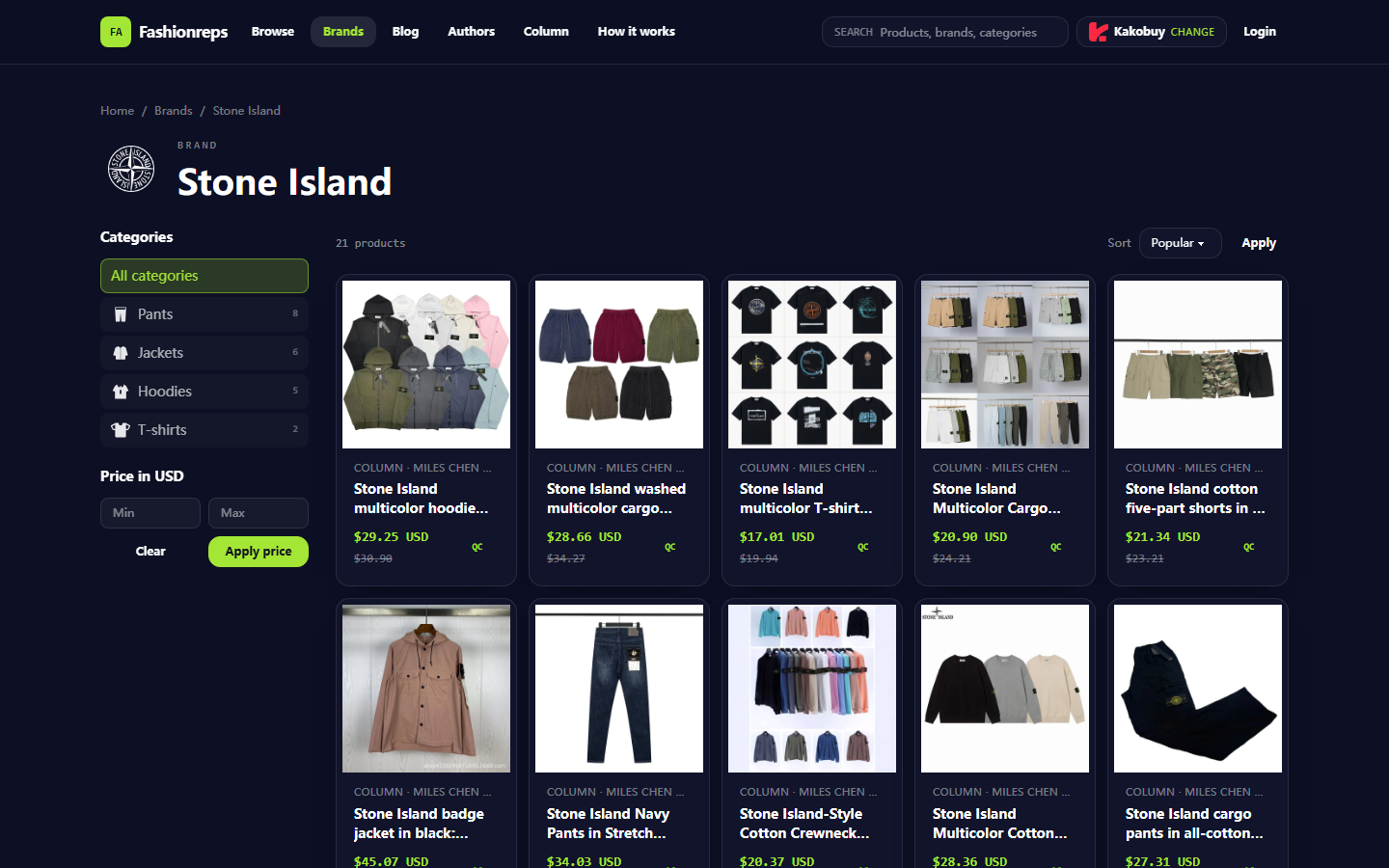
The currently visible fashionreps Stone Island brand page shows 21 products, with page categories including pants, jackets, hoodies, and t-shirts; in the page snapshot, no hat category or explicit hat product name is visible. Therefore, the page cannot currently be used as valid product evidence for Stone Island hats, nor can it be used to judge that a certain agent has stock, accurate prices, or purchasable links. ⚠️
This article does not apply to after-sales dispute handling once you already have a specific hat product page, seller link, or order number. That type of issue requires re-verifying the product page, order records, QC images, and platform policies.

Caption: Screenshot of the fashionreps Stone Island brand page used for this verification, to confirm the visible product range, not to indicate that hat products already exist or have passed QC.
Verify Style, Color, Size, and Visible Links from the fashionreps Product Page
A qualified hat product page should at least allow buyers to complete four actions: confirm the product name, identify the style or color, view available sizes or fit instructions, and save a page entry that can return to the product. If the page only has brand tags, search terms, or an image that cannot be associated with a specific product, it should not be used as a basis for ordering.
It is recommended to record in the following order:
- Does the product name explicitly state the hat category, such as baseball cap, beanie, or other specific style.
- Does the color correspond to the current options, rather than just showing one color in the main image.
- Are there size, head circumference, adjustable structure, or fit instructions.
- Can the product images clearly show key parts such as badge, brim, stitching, lining, and closure structure.
- Does the page retain seller information, visible update time, or other traceable fields.
- After clicking the Buy button, does the selected agent still recognize the same product, rather than jumping to a generic search page.
In this brand page snapshot, what can be confirmed is the existence of the Stone Island brand collection, with several clothing products and reference prices displayed. It cannot confirm the style, color, size, stock, seller, shipping, or return conditions for hats. The reference prices on the page also cannot be transferred to hat products.
Record Evidence Such as Product Images, QC Entry Points, and Page Update Time
QC evidence should be built around the same product, and cannot be assembled from brand page screenshots, other product images, and agent pages into a seemingly complete evidence chain. It is recommended to save the following items:
- Product page screenshot: including product name, options, and page entry.
- Product image record: indicating whether it is a seller image, product page image, or warehouse QC image.
- Key parts checklist: badge, brim, fabric texture, inner label, stitching, and size measurements.
- QC status: not yet in stock, awaiting photos, images generated, manually reviewed, or issues present.
- Page time: record the verification date, do not treat historical prices or historical stock as current facts.
- Processing result: keep, consult, request additional photos, return/exchange, or stop purchasing.
"Having images" does not equal "having QC evidence." Seller display images can only help discover the product, but cannot prove that the specific item shipped matches the image. Warehouse QC images can only prove the appearance captured, but cannot automatically prove material authenticity, brand authorization, or long-term durability. 🔎
If the page does not clearly show a hat product, the safest way to record is to mark it as "no valid product page found," rather than using other Stone Island clothing pages as substitute samples.
Compare Different Agents' Product Discovery Steps Using the Same Purchase Task
The fashionreps page shows multiple shopping agents available for selection. This entry only indicates that the platform provides a selection mechanism, and does not prove that each agent has the same inventory synchronization, image quality, customer service response, or after-sales policy for the same product. When comparing, you should fix the same product link, same color, and same quantity to avoid misjudging agent differences due to different products.
| Comparison Item | Facts to Record | Conclusions Not to Directly Infer |
|---|---|---|
| Product Discovery | Actual page the Buy button jumps to, whether product name is retained, whether options are complete | A certain agent definitely has stock or lowest price |
| Pre-order Confirmation | Product link, seller info, visible specs, customer service reply | Customer service reply equals stock commitment |
| QC Process | Whether warehouse images are provided, whether additional photos are possible, which parts images cover | Having QC entry means product quality is reliable |
| Fees and Routes | Product fee, service fee, domestic shipping, international shipping, and applicable conditions | Reference price equals final landed cost |
| After-sales Handling | Return/exchange conditions, time window, evidence requirements, and liability boundaries | All issues can be unconditionally refunded |
Without actually opening the same hat product page for each agent individually and completing remote readback, only process design and verifiable fields can be compared, and no ranking or "best agent" conclusion can be given. If an agent's page cannot confirm the product, has a broken jump, or is empty, it should be recorded as insufficient evidence, rather than interpreting the failure as the platform definitely not supporting that product.
Compare QC Viewing, Consultation Support, and Follow-up Processing Conditions
For hats, where sizes are relatively concentrated but silhouette and structure differences are obvious, QC focus should not be only on the front main image. Buyers should at least confirm the hat circumference or adjustment structure, brim shape, badge attachment method, inner label, stitching, and obvious stains or damage. If the hat is knitted or soft material, also pay attention to flat lay status and whether there is obvious deformation, but do not write photo observations as if you have touched the fabric.
When comparing agents, you can break the issues into three levels:
- Product level: Can the same link, same color, and same specifications be confirmed.
- QC level: Can images covering key parts be provided, and is reasonable additional photography supported.
- After-sales level: After discovering obvious problems, can evidence be submitted within the specified time and a clear processing path obtained.
Editor's judgment: If the product page itself has not been confirmed, directly comparing QC quality is meaningless. First confirm the product exists, then compare image coverage, and finally compare consultation and after-sales conditions. This avoids mistaking "page can open" for "product can be purchased," and also avoids mistaking "can contact customer service" for "problem will definitely be solved." ✅
Distinguish Between Page Facts, Community Clues, and Editorial Judgment
In purchase decisions, three types of information need to be kept separate:
- Page facts: categories currently visible on the brand page, product names, price fields, buttons, and page status.
- Community clues: sellers, batches, or QC experiences mentioned by other buyers or in discussion areas. Community content needs to record the original post time and whether it was read completely, and cannot treat a single comment as a universal conclusion.
- Editorial judgment: based on whether evidence is sufficient, decide to continue verification, consult, wait for additional evidence, or stop purchasing.
What can be confirmed as page facts this time is that the Stone Island brand page exists and displays clothing products; what cannot be confirmed this time is a valid product page, real-time stock, actual seller, final cost, or QC records for Stone Island hats. Without such evidence, any claims like "hats are well made," "a certain agent is more reliable," or "already in stock" are unverified judgments.
Evidence Supplementation Sequence and Stop Conditions When Information is Insufficient
It is recommended to supplement evidence in the following order:
- Search for specific hat categories on fashionreps, not just the brand name.
- Open the actual product page in the search results, confirm the name, images, options, and page entry.
- Record the verification date, and re-check whether the page redirects, is empty, or only shows tags.
- Use the same product entry to separately check the jump results of the target agents.
- Before ordering, consult the agent about stock, spec confirmation, QC images, and after-sales time window.
- Only proceed to purchase decision after product, cost, and processing conditions are all recorded.
Stop and wait for new evidence if any of the following occurs: the product page is inaccessible; the page has no clear product name; hat specifications cannot be confirmed; the Buy button jumps to an irrelevant page; QC images cannot be matched to a specific order; customer service only gives vague promises that cannot be verified; or page information is inconsistent with the agent page. 🛑
Stopping the purchase does not waste verification work. Keep the recorded page screenshots, dates, questions, and missing fields, and continue when an accessible specific product page appears, to reduce repeated searches and wrong orders.
Decision Checklist After Comparing Stone Island Hats Across Platforms
Under current evidence, it is not recommended to directly purchase hats based on the Stone Island brand page, because the page snapshot does not provide a confirmable hat product record. The next step should prioritize finding a valid product page, then use the same link to compare different agents' jumps, spec retention, QC images, and after-sales conditions.
Before making a decision to continue, confirm the following items:
- [] Product name clearly belongs to hats, not other clothing.
- [] Style, color, and size or head circumference information visible.
- [] Product images correspond to the product name.
- [] Page entry accessible on the verification date.
- [] Target agent can recognize the same product and options.
- [] QC image requirements cover badge, brim, inner label, stitching, and size information.
- [] Fees, routes, taxes, and applicable conditions have been individually verified.
- [] Return/exchange window, evidence requirements, and liability boundaries recorded.
As for savings, there is currently no verifiable sample of hat product prices, shipping, or agent fees, so it is impossible to calculate how much can be saved through combined shipping or platform selection. The cost of continuing verification is time and possible consultation fees; the risks of blind ordering include product mismatch, spec non-compliance, insufficient QC evidence, and inability to provide proof for after-sales. Those suitable to continue are buyers who already have a specific product link and are willing to save evidence item by item; those not suitable for quick ordering are buyers who cannot confirm the product page, specs, or after-sales conditions.