Loro Piana Scarf Shipping: Volumetric Weight, Terms
Before sending a scarf, the most common mistake is to look only at the product page price and then mix packaging, volumetric weight, route, and destination fees together for comparison. A more reliable approach is to first confirm the package conditions, then record each fee separately; as long as the actual weight, outer box dimensions, destination, or route are not yet determined, you should not treat any shipping figure as the final cost. 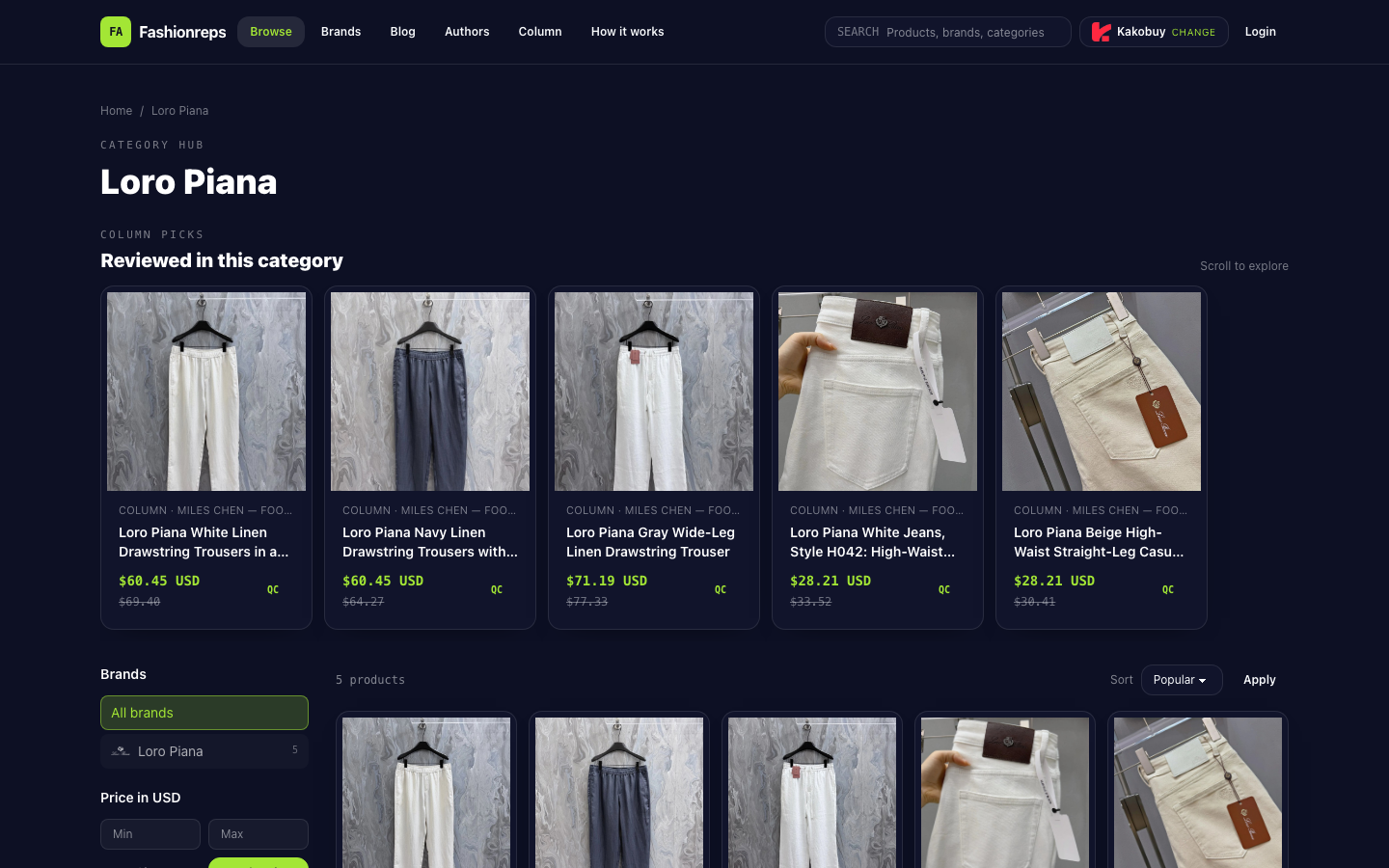
Editor score 4.2 / 5
Reading contents
Before sending a scarf, the most common mistake is to look only at the product page price and then mix packaging, volumetric weight, route, and destination fees together for comparison. A more reliable approach is to first confirm the package conditions, then record each fee separately; as long as the actual weight, outer box dimensions, destination, or route are not yet determined, you should not treat any shipping figure as the final cost.

First, Confirm This Is a Calculable Scarf Package
The page evidence currently provided is the Fashionreps Loro Piana category page. The page lists five Loro Piana pants entries and their reference prices, but it does not provide the scarf product's color, size, stock, packaging status, actual weight, outer box dimensions, or shipping cost to a specific destination. Therefore, this information cannot be used directly to calculate the shipping cost of a Loro Piana scarf, nor can it be used to infer the scarf's price or shipping cost.
Before shipping, the following information should be completed:
- The exact product page, color, and size of the target scarf.
- Whether the product is currently still available for purchase, and the currency of the price.
- The actual weight of the product after it arrives at the warehouse.
- Whether the original packaging, gift box, tags, or other accessories are retained.
- The length, width, and height of the outer box after packaging is complete.
- The destination country or region, postal code, and acceptable shipping routes.
- The query time and pricing rules shown by the agent's calculator.
- Whether taxes, insurance, remote area surcharges, and fuel surcharges are included.
Break Down the Costs into Checkable Items
Don't first ask "how much is shipping for this scarf?" Instead, create an itemized record. Product price, platform service fees, payment fees, packaging fees, and international shipping fees are usually not part of the same pricing stage; different service providers may also display them differently.
| Item | What to Check | Handling When Missing |
|---|---|---|
| Product Price | Current price on product page, currency, query time | Do not output converted specific amounts |
| Service Fees and Payment Fees | Whether listed separately by agent or payment page | Do not treat product price as order total |
| Packaging Fees | Whether there are options like reinforcement, box replacement, removal of original packaging | Confirm packaging plan before comparing |
| Actual Weight | Warehouse weighing result and unit | Do not substitute with common sense weight of a scarf |
| Volume Dimensions | Length, width, height after packaging | Do not estimate with unpackaged dimensions |
| Chargeable Weight | Whether route uses actual weight or volumetric weight | Use the corresponding route calculator |
| Taxes and Surcharges | Destination rules, insurance, remote areas, etc. | Mark as not included separately |
How to Assess Volumetric Weight
Volumetric weight is not the weight of the product itself, but the chargeable weight calculated by the carrier based on the space occupied by the package. Common formulas use length, width, height, and a route-specific volumetric coefficient, but different routes may have different coefficients and rounding rules. When there is no official route calculator formula, you should not apply a fixed coefficient on your own.
When actually checking, first obtain the three side dimensions after packaging is complete, then check the billing instructions for the target route. If the page explicitly compares actual weight and volumetric weight, you should usually record both and confirm whether the route ultimately uses the larger value or other rules. Units must also be unified; mixing centimeters, inches, grams, and kilograms will make results incomparable.
For small and light items, packaging method is especially important. Keeping the gift box, using a larger outer box, or adding cushioning materials may change the volume; but without measured dimensions, you cannot assert which packaging is definitely cheaper. You can ask the warehouse to provide weighing and measurement results first, then decide whether to remove unnecessary outer packaging.
Destination Conditions Change the Comparison Results
The same package cannot be compared for shipping costs without specifying the destination. At minimum, fix the country or region, postal code, shipping route, and query time. Some routes may restrict textiles, brand logos, or specific packaging, and may also handle taxes, insurance, or remote area fees separately. Until these conditions are confirmed, you can only compare quote terms, not the final landed cost.
It is recommended to record each query as a row to avoid mixing quotes under different conditions:
- Query date and time.
- Destination country, region, and postal code.
- Route name.
- Actual weight and unit.
- Outer box length, width, height, and unit.
- Chargeable weight shown by calculator.
- Currency of product price, service fees, payment fees, packaging fees, and shipping fees.
- Whether taxes, insurance, and surcharges are included.
- Quote validity period or page notes.
When to Pause Shipping
If any of the following occurs, first supplement the information and do not use estimated numbers for payment decisions:
- The valid product page for the target scarf cannot be found, and the product price or purchase status cannot be confirmed.
- Only product photos are available, without warehouse actual weight and packaged dimensions.
- The destination only has a country, without region or postal code, while the route prices by address zone.
- The calculator does not explain the volumetric weight formula, rounding method, or cost inclusion scope.
- The quote does not indicate currency, query time, or whether tax is included.
- Packaging plan is not yet determined, but quotes from different routes are already being compared.
An Actionable Calculation Sequence
First step: save the product information of the target scarf page, confirm color, size, price, currency, and current purchase status. Existing evidence only covers the Loro Piana pants category page and cannot replace scarf page evidence.
Second step: after the product is in the warehouse, record the actual weight and ask the warehouse how keeping original packaging, removing original packaging, or reinforcing packaging will affect dimensions and costs.
Third step: after determining the packaging plan, obtain the outer box three side dimensions. Do not replace outer box dimensions with unpackaged scarf dimensions.
Fourth step: enter the fixed destination, route, weight, and dimensions into the target agent's official calculator, and save the displayed result and query time.
Fifth step: record product price, service fees, payment fees, packaging fees, international shipping fees, taxes, and surcharges separately. Only when all items have consistent terms is it appropriate to compare routes or packaging plans.
Sixth step: if key fields are still blank, mark the order as pending information, rather than filling in a seemingly precise total.
Conclusion
The core of calculating the shipping cost of a Loro Piana scarf is not to apply a fixed shipping fee to the scarf, but to first lock in the packaging status, actual weight, outer box volume, and destination conditions of the small and light item. The currently provided evidence lacks scarf product and route calculator data, so it is impossible to provide a credible product price, volumetric weight, or final shipping cost. Once the target page, warehouse measurement results, and corresponding route quotes are complete, compare by cost item one by one, and the results will have practical decision-making value.