How to Verify Moncler Jacket Sizing, Fill, and Commute Fit
This verification guide is for buyers who are browsing moncler fall/winter jacket product pages on fashion-reps but are still unsure about sizing, fill descriptions, and daily commute suitability. The goal is not to endorse the product, but to help you complete a set of reviewable page evidence checks before saving, inquiring, or holding off on a purchase. Current page information can only support limited judgments: the QC page shows that there are 3 sty
Editor score 4.2 / 5
Reading contents
This verification guide is for buyers who are browsing moncler fall/winter jacket product pages on fashion-reps but are still unsure about sizing, fill descriptions, and daily commute suitability. The goal is not to endorse the product, but to help you complete a set of reviewable page evidence checks before saving, inquiring, or holding off on a purchase.
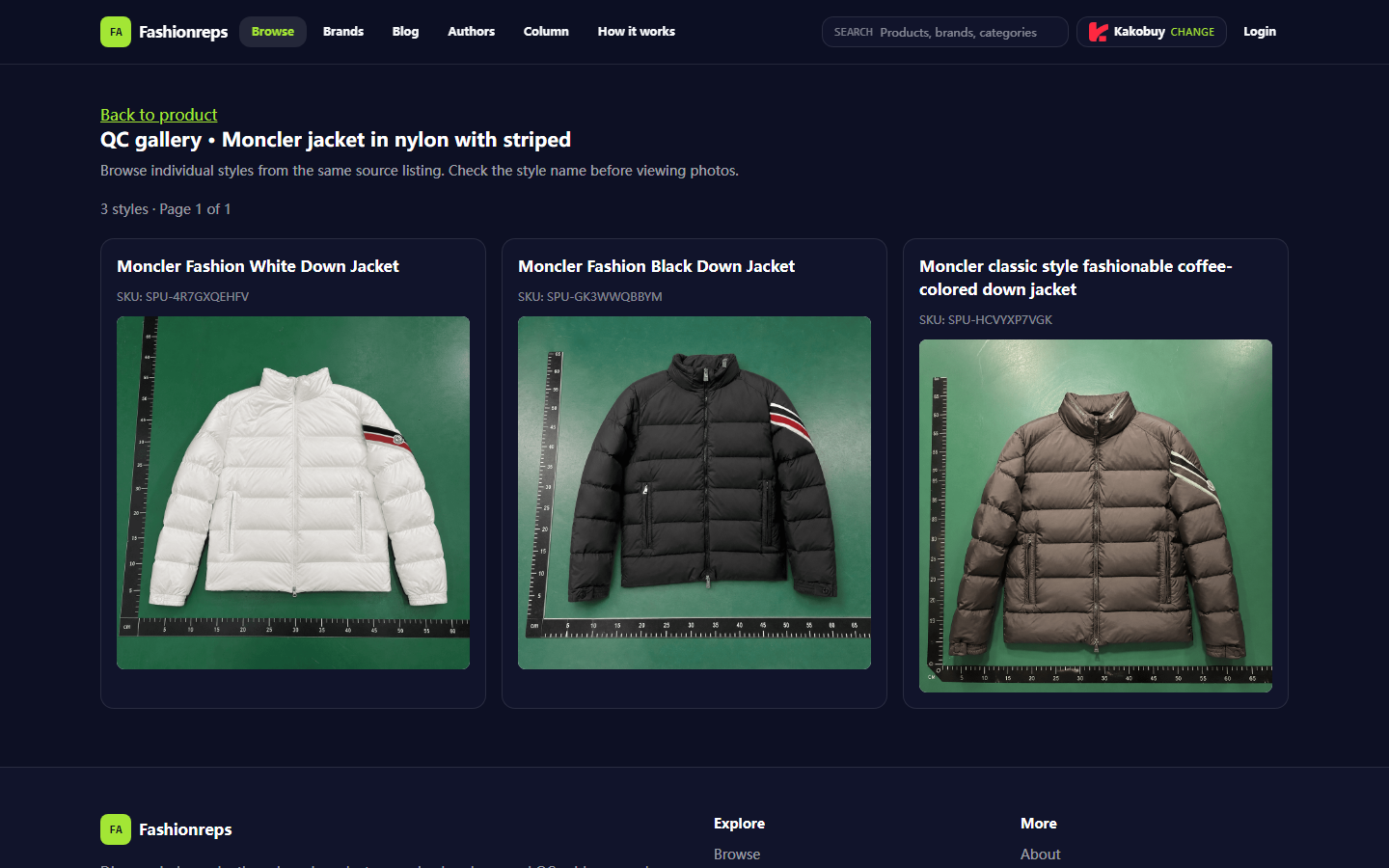
Current page information can only support limited judgments: the QC page shows that there are 3 styles under this source, including a black down jacket, a white down jacket, and a coffee-colored classic down jacket, with SKUs listed separately. The page title also includes descriptions like nylon and striped, but these words alone cannot prove fill composition, warmth rating, stock status, or actual wearing effect. 📌

The Purchase Decision This moncler Fall/Winter Jacket Verification Aims to Resolve
Before proceeding with an order, first frame the issue as a clear decision:
Do I already have enough evidence to confirm that the style, color, size, and construction description of this jacket match my commuting needs?
After reading this guide, you should be able to:
- Confirm that you are looking at the correct style, not an adjacent variant from the same source.
- Record the page name, visible images, size information, and seller-confirmed items separately.
- Assess whether this jacket is suitable for your commuting temperature, activity level, and layering.
- Pause the purchase when evidence is insufficient, rather than substituting brand name or main product image for verification.
If you need completed physical measurements, exact fill ratio, real stock confirmation, or personally masked QC records, this page check cannot replace that evidence. The product name and images on the page can help with filtering, but they cannot prove that the garment has achieved certain warmth, durability, or water resistance performance. 🧥
How to Confirm Style, Color, and Size from the fashionreps Product Page
First check the page path and page type. What is currently provided is a QC gallery page, not a complete product detail page from which all purchase conditions can be directly confirmed. Before entering the images, verify the style name shown on the page to avoid mixing different colors or constructions from the same source.
The three visible style names on the page include:
- Moncler Fashion White Down Jacket, SKU SPU-4R7GXQEHFV.
- Moncler Fashion Black Down Jacket, SKU SPU-GK3WWQBBYM.
- Moncler classic style fashionable coffee-colored down jacket, SKU SPU-HCVYXP7VGK.
These names can serve as page identification clues, but should not be taken directly as complete specifications. Especially the word "down" in the product name only indicates that the title uses this term; it cannot be used to infer fill ratio, fill weight, loft, or temperature range.
It is recommended to transcribe the following fields into your own verification record:
- The style name displayed on the page.
- Whether the color name matches the actual tone in the images.
- SKU or page identifier.
- Whether an independent size chart exists.
- Whether the size chart uses body measurements or garment measurements.
- Whether the images show collar, cuffs, hem, zipper, pockets, and quilting structure.
- Whether the page clearly states stock, shipping time, and seller contact information.
If the color name, images, and style name contradict each other, save a page screenshot first and stop selecting. Do not infer true color differences from color thumbnails, and do not treat other style images from the same page as evidence for the target style. 🔎
Which Visible Fields Should Be Recorded for Fill, Fabric, and Construction Descriptions
When verifying fill descriptions, facts need to be divided into three layers.
The first layer is the text directly written on the page, such as "down," "nylon," or "striped" appearing in the title. The second layer is the structure that can be directly observed in the images, such as whether quilting lines, hood, stand collar, zipper, pockets, and cuffs are visible. The third layer is the specifications that still need to be supplemented by the seller or QC, such as the specific type of fill, ratio, weight, fabric weight, water-repellent treatment, and lining material.
When only the first and second layers exist, the third layer cannot be filled in as confirmed fact. A more prudent recording approach is:
- "The page name uses down-related terms, but no fill ratio evidence is seen."
- "Images can be used to observe external structure, but they cannot prove fabric feel or warmth performance."
- "The page contains a nylon description, but the specific fabric composition, thickness, and treatment still need confirmation."
- "Quilting appearance can serve as structural clue, but it does not verify fill evenness."
If the seller responds with specifications, require clear answers rather than accepting unverifiable expressions like "same as retail" or "high quality." You can ask:
- What exactly is the fill, and can you provide ratio or weight information?
- Is the size chart garment flat measurements or body recommended sizes?
- What are the materials of the outer fabric and lining?
- Can you provide QC images for the target color and target size?
- Do the images correspond to the current SKU, and not other colors from the same series?
In the absence of such evidence, editorial judgment should remain "page description limited," rather than "fill reliable" or "fabric premium."
How to Match Size Chart, Fit, and Commuting Wear Needs
The first step in size verification is not to directly choose your usual letter size, but to confirm the measurement standard. For outerwear, you usually need to consider chest width, shoulder width, garment length, sleeve length, and whether you need to layer a knit sweater or hoodie inside.
If the page does not have a visible size chart, it is recommended to first measure a jacket that fits you well and record the following data:
- Chest width: the left-right distance at the underarm level.
- Shoulder width: the distance between the shoulder seams.
- Garment length: the length from the highest point of the shoulder to the hem.
- Sleeve length: the length from the shoulder seam to the cuff.
- Hem width: the left-right distance of the hem when laid flat naturally.
After measuring, do not compare just one number. Commuting wear usually requires room for layers, but excessive shoulder width, overly long sleeves, or overly wide hem may also affect mobility when cycling, taking public transportation, and being indoors.
You can judge according to the following approach:
- If you mainly wear thin inner layers, prioritize checking if shoulder width, chest width, and sleeve length are excessive.
- If you need to layer a hoodie or knitwear, prioritize confirming chest width, armhole mobility, and hem space.
- If you often cycle or walk, focus on whether garment length, cuffs, and hem affect movement.
- If you need to switch between office and outdoors, consider bulk, packability, and indoor overheating.
- If you are particularly sensitive to body proportions or sleeve length, you must ask the seller to provide actual measurements for the target size.
Without a size chart or actual measurement data, you cannot infer that the fit is necessarily loose, slim, or suitable for commuting just because the product name includes "classic style." Fit judgment must be based on visible dimensions, structural images, or clear measurements.
How to Preserve Evidence When Product Images and Text Conflict
When encountering inconsistencies between text and images, first save the complete context rather than just a partial screenshot. The record should include page name, SKU, screenshot time, target color, target size, and the location of the contradiction.
Common contradictions include:
- The name says black, but the image shows a clearly different color.
- The name says striped, but the corresponding structure or pattern is not visible in the images.
- The product title says down, but the page has no fill information or close-up structural images.
- The selected SKU does not match the QC image name opened.
- The same page mixes images from multiple colors or styles.
When asking the seller, focus on one contradiction at a time and ask them to point out which SKU the image corresponds to. Do not just ask "is it authentic" or "how is the quality," because such questions usually do not yield verifiable answers.
If the other party cannot confirm the image attribution, mark the item as pending rather than inferring based on the closest image. When saving evidence, mask order numbers, names, addresses, phone numbers, payment information, and complete shipping labels to avoid exposing personal information. 🛡️
How to Separate Page Information from Editorial Judgment
To avoid writing speculation as fact, you can divide your verification record into three columns: page facts, unconfirmed, and purchase judgment.
Page facts only include content that can be seen or clearly read on the current page, such as style name, color name, SKU, structures visible in images, and whether a size chart is provided. Unconfirmed items include fill ratio, weight, stock, actual measurements, fabric treatment, and after-sales conditions. Purchase judgment is based on your own commuting scenario, deciding whether to continue inquiring, save for observation, or hold off.
For example, a prudent judgment would be:
"This page provides multiple color and style identification clues, but the current evidence is insufficient to confirm fill specifications and actual dimensions for the target size. If the buyer needs to layer for commuting, they should first obtain a size chart and QC images for the target style before deciding whether to proceed."
Unsound judgments include "very warm," "suitable for all winters," "fit definitely good," "ample stock," or "quality verified." These conclusions all require additional evidence directly corresponding to the target item.
The fashion-reps page can help users discover products and view available QC entries, but orders, payment, shipping, and after-sales are handled by the shopping agent website the user ultimately chooses. Page browsing results do not equal the agent confirming stock, nor do they equal the product having been purchased.
Stop Conditions When QC, Stock, or Specification Evidence Is Missing
If any of the following situations occur, it is recommended to stop placing the order and switch to inquiry or hold:
- The target color has no corresponding image, or the image cannot be confirmed to belong to the target SKU.
- There is no size chart, and actual garment measurements cannot be obtained.
- Fill description contains only promotional words without composition, weight, or other verifiable information.
- There are unexplained contradictions between product name, images, and SKU.
- It cannot be confirmed whether the current page information still corresponds to an available product.
- The seller cannot answer basic specification questions or only provides vague promises.
- You need clear performance in warmth, water resistance, abrasion resistance, or commuting activity, but the page lacks corresponding evidence.
Stopping does not negate the product; it indicates that the current evidence is insufficient to support this purchase decision. This can reduce losses from incorrect sizing, color discrepancies, specification mismatches, or subsequent disputes.
Actions After Verification: Save, Inquire, or Hold Off Purchase
When evidence is relatively complete, you can save the target style and keep the style name, color, SKU, size data, and pending questions in one record. Before submitting the order, re-check the style, size, price, stock, and return/exchange conditions shown on the agent's end; these are time-sensitive and should be based on the page on the day of purchase.
If sizing or fill specifications are unclear, prioritize sending short, specific questions and require answers corresponding to the target color and target size. If the other party only confirms "in stock" without addressing size and structure issues, you still should not treat the stock response as complete verification.
If your primary need is an urban commuter jacket, it is recommended to base your judgment on measurable dimensions, layering space, mobility, and indoor usage scenarios, rather than only brand name or promotional words. If you need extreme cold protection, protective outdoor gear, a clear waterproof rating, or traceable fill certification, it is not advisable to decide based solely on the current product page.
The final record can be simplified into three outcomes:
- Proceed: style, color, size, and key specifications have mutually corresponding evidence.
- Need inquiry: the product has a clear target, but size, fill, or QC information is still missing.
- Hold off purchase: page contradictions are unresolved or key evidence cannot be obtained.
This method does not guarantee purchase results, nor does it replace the agent's order, payment, logistics, and after-sales rules. Its value lies in turning "looks like a good fit" into a set of reviewable purchase conditions, and stopping in time when evidence is insufficient.