Gray Utility Jacket with Green-Sleeve Top Flat Lay
Introduction The gray utility jacket and the long-sleeve top with a white body and army green sleeves are placed in the same frame, creating layers of cool gray, bright white, and muted green. This combination is suitable for observing garment construction and for referencing everyday fall/winter styling and color coordination in flat lay displays. 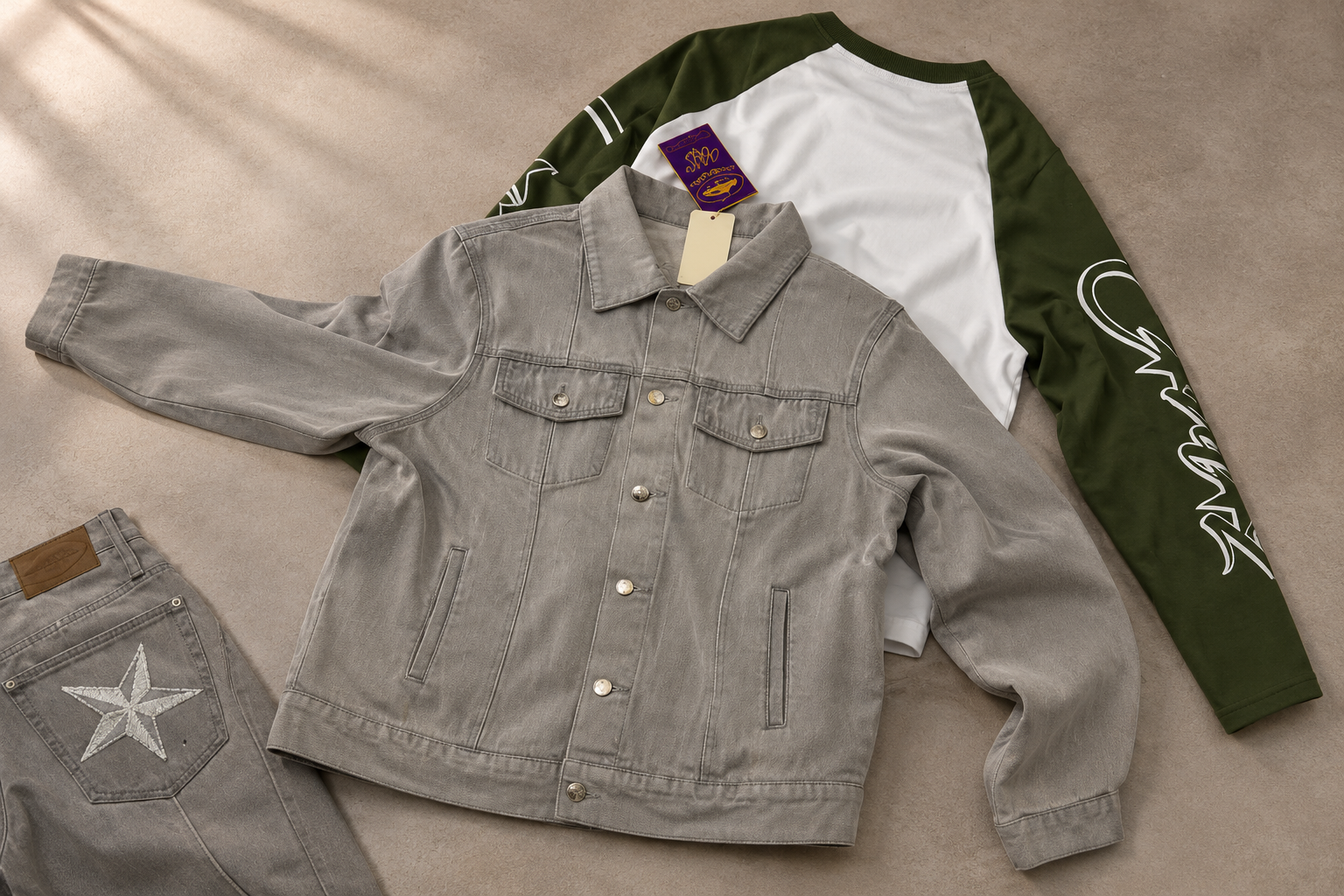
Editor score 4.2 / 5
Reading contents
Introduction
The gray utility jacket and the long-sleeve top with a white body and army green sleeves are placed in the same frame, creating layers of cool gray, bright white, and muted green. This combination is suitable for observing garment construction and for referencing everyday fall/winter styling and color coordination in flat lay displays.

Color Relationships in the Image
The gray jacket is the main color in the image, with a low-key tone that can balance the white and army green. The white body provides brightness contrast, making the army green sleeves and the jacket's silhouette more visible; the army green adds visual weight so the overall look doesn't become too monotonous.
When styling, you can use gray as the base color, place white near the face, and use army green as a local accent. For bottoms, prioritize black, dark gray, or gray in the same color family, and avoid adding too many highly saturated colors. If you want a lighter overall look, you can choose off-white bottoms or light gray accessories, but keep patterns on other items simple.
Jacket Structure and Layers
The gray jacket in the image features a lapel design, with double chest pockets, side entry pockets, and multiple metal buttons on the front. The chest pockets, placket, and body seams together form clear vertical and horizontal lines, giving the flat lay a structural feel common in utility clothing. On the jacket's edges, you can also see large curved and star-shaped line art prints on the back, adding graphic details to the plain body.
If worn as an outer layer, you can pair it with the white body from the image as the inner layer, letting a small amount of white show at the collar, placket, or hem. This preserves the gray jacket's dominant position while echoing the white part of the long-sleeve top. If you want to highlight the line art prints on the jacket, keep the inner layer and bottoms free of complex prints.
Styling Focus for the Long-Sleeve Top
The white body and army green sleeves create a clear color-blocked relationship, and the white graphic prints on the sleeves further enhance the horizontal extension. When worn alone, you can pair the army green with dark gray, black, or brown for a composed look; when layered under the gray jacket, the army green sleeves can become the main identifying point of the overall outfit.
When layering, pay attention to the exposed area of the prints. If the sleeve prints are already eye-catching, no need to add large-scale patterns on the inner layer. For flat lay displays, you can slightly offset the sleeves of the two garments so that the white body, army green sleeves, and gray jacket's silhouette are all visible without covering each other.
How to Make Flat Lay Displays Clearer
This image uses a diagonal layout: the gray jacket is at the visual center, the color-blocked top is spread out behind it, and the gray bottoms are at the lower left. The central piece handles the main detail display, the garment behind supplements the color, and the edge piece provides area and directional variation.
You can arrange items in the following order:
- First, place the piece whose structure you want to observe in the center, making sure the lapels, pockets, buttons, and main seams are fully visible.
- Then, place the color-contrasting inner layer behind or to the side, exposing only the key areas of the white body and army green sleeves.
- Arrange the sleeves and pant legs along diagonal lines, which gives the image more dynamism than a completely horizontal or vertical arrangement.
- Keep some overlap between different garments, but do not cover identifying details such as pockets, prints, and plackets.
- Use a background close to beige-gray to complement the gray, white, and army green while keeping the image soft.
Details to Note When Choosing Styling Options
The image is suitable for assessing colors, color-block placement, pocket layout, button arrangement, and some print details, but the jacket's hem and cuffs are not fully shown. Therefore, to further judge the overall fit, you should view images that include the full garment length, shoulders, cuffs, and back; to judge the wearing effect, you also need to refer to specific product specifications and size information. Based on this flat lay alone, you cannot determine material composition, actual size, comfort, durability, or washing performance.
Overall, the gray jacket is suitable for providing the structural base of an outfit, and the white and army green color-blocked top is suitable for providing contrast and pattern focus. By keeping the three colors within the gray, white, and green range, and supplementing with black, dark gray, or off-white, you can maintain a clear and layered display and styling effect.