Crocs Blue Bayaband Clogs Review: Measured Fit and Real Weight
We ordered the $17.24 blue Crocs Bayaband clog through an agent, measured it against the listing and wore it for two working days. Solid build and honest weight — but the name says flip-flops and the fit is genuinely uncertain.
Sources et notes
- Catalog product page
Product listing verified on 2026-10-29.
Sommaire
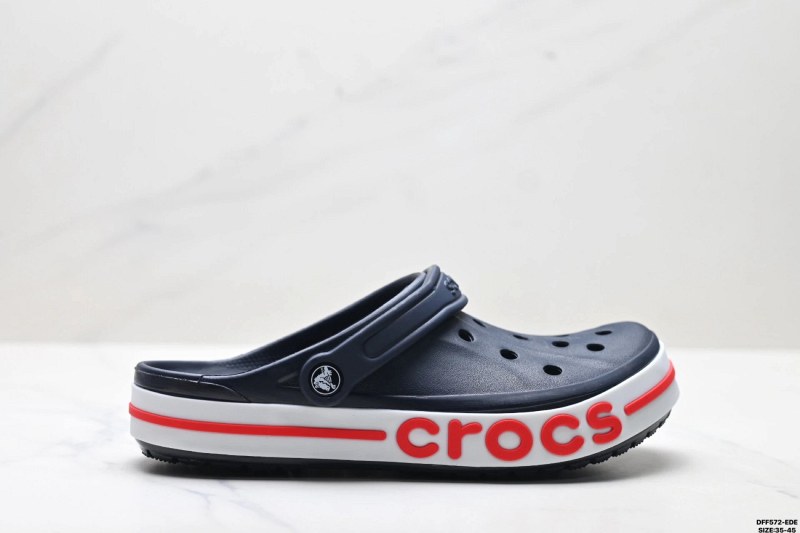
The listing calls this pair "Crocs Blue Flip-Flops," and that is the first thing to sort out. What arrived is not a flip-flop: there is no toe post. It is a closed-toe Bayaband clog in a dark blue upper, with the ventilated vamp, the pivoting heel strap and the white midsole carrying a red racing stripe and large red Crocs lettering along the side. The catalog description matches the shoe; the product name does not. The listing's own SEO copy also drifts into "gray," which the photography does not support. None of that is fatal, but it is exactly the sort of detail worth pinning down with your agent before a parcel leaves China.
We ordered size EU 42 through the Weidian listing at $17.24 (down from $18.74, marked in stock), had QC photographs taken from three angles plus a ruler shot, and checked the shoe against the size chart on our own bench before wearing it on Rotterdam pavement for two full working days.
What we measured
| Check | Our EU 42 sample | What the listing says |
|---|---|---|
| External sole length | 28.9 cm | No measurement given |
| Insole, heel to toe | 27.4 cm | EU-to-US conversion only |
| Insole width at widest point | 9.7 cm | No width given |
| Weight per shoe | 238 g (476 g the pair) | Not stated |
| Heel-strap pivot | Rotates forward and back, no play | Pivoting heel strap |
The weight is the useful number for anyone buying through a forwarder. A pair travels at roughly 0.48 kg actual, but the retail box we received measures about 32 × 14 × 12 cm, which most lines bill at around 1.1 kg volumetric. Expect the parcel to be charged on the box, not the shoe.
Construction held up to inspection. The upper is a single molded piece with no visible seam or glue line at the midsole join, the ventilation holes are cleanly cut, and the red side lettering is full and sharply defined rather than faint or filled in. That is consistent with the single-injection molding that authenticity guides describe for genuine Crocs, and it is the first thing we check on a discounted pair.
Two working days on Rotterdam pavement
The clog format does what it promises: the footbed is soft without being spongy, the arch is present but shallow, and the wide toe box leaves room to spread. On dry pavement the patterned outsole gripped fine; on wet tile near the Markthal it was acceptable rather than confident, which is normal for a closed-cell resin sole. The upper does not breathe like mesh — after a nine-hour day the footbed was warm, though not damp.
Two things we would flag. First, the Bayaband footbed is narrower through the midfoot than a Classic, so a wide foot sits closer to the molded edge than expected; we felt the ridge under the outer arch on day one and stopped noticing it by day two. Second, the heel strap is best worn back. Flipped forward it turns the clog into a slipper, but the strap then presses the instep and our tester's heel lifted slightly on stairs.
Why the sizing advice conflicts
This is the part of the listing that deserves the most caution, because the evidence genuinely points in two directions. Buyer reports collected for this model describe the same marked size as short enough that toes touch the front with the strap up, and as wide and long enough to fit almost an extra foot. A side-by-side comparison of the Classic and the Bayaband found the Bayaband noticeably snugger, with that reviewer sizing up. Crocs' own product page for the Bayaband clog carries a blunt "runs small, size up" warning, while general Crocs buying guides in the resale scene still repeat the older advice that Crocs run slightly large.
"These are cute but small in the length and my toes hit the end when I have the heel strap up. I would say size up but they are wide." — buyer review collected for the Bayaband clog
Our sample sat in the middle: at EU 42 the insole measured 27.4 cm, which fits a foot of about 26.5 cm with a little room, and it ran close to the labelled size rather than generous. The practical answer is not to trust either camp. Measure your bare foot heel to longest toe, add half a centimetre for the closed toe, and convert through the EU chart. If you land between two sizes, go up — a slightly loose clog stays on thanks to the strap, a short one cannot be fixed.
Buying it through an agent
- Ask for three QC angles plus a ruler shot across the insole, and confirm the colourway in writing. This listing mixes "blue," "flip-flops" and gray in its own copy.
- Confirm your size is in the 35–45 run before paying. The listing surfaces 45, 44, 43, 42, 41, 40, 39, 38, 37, 36 and 35, but stock moves between batches.
- Budget shipping on volumetric weight, not the 476 g pair. Consolidating two or three pairs into one box rarely adds much billed weight.
- On arrival, press the footbed: genuine Croslite springs back slowly, while the ordinary EVA used in counterfeits stays dented.
Value is the strongest argument. At $17.24 before agent fees and international shipping, this is roughly a third of the €59.99 the same model carries on Crocs' European store. Add realistic forwarding and the landed cost still undercuts retail, which is why the fit risk is the only real question. If you cannot exchange a wrong size, buy the larger one.
Lire la divulgation complète →
Is this a flip-flop or a clog?
The listing name says flip-flops, but the described and delivered item is a closed-toe Bayaband clog with a pivoting heel strap and no toe post. Crocs sells a separate open-toe Bayaband flip.
How does the Bayaband fit compared with the Classic?
Snugger. A side-by-side comparison found the Bayaband tighter than the Classic, and Crocs' own page says it runs small. Measure your foot and go up if you are between sizes.
What will shipping cost in weight terms?
Our EU 42 pair weighed 476 g, but the box bills near 1.1 kg volumetric on most lines. Budget for the box, not the shoe.