How to Verify Stussy Hoodie Consolidation Costs
## First, Define the Cost Problem of Hoodie Consolidation When buying fall/winter hoodies, the listed price on the product page is just the starting point. What you really need to verify is: how much you pay for the item itself, whether the shopping agent charges a service fee, whether there are extra costs at the payment stage, how the warehouse packs, which shipping line charges by what weight, and whether the destination country may incur taxes or customs clearance fees. 🧾 This guide is for
Editor score 4.2 / 5
Reading contents
First, Define the Cost Problem of Hoodie Consolidation
When buying fall/winter hoodies, the listed price on the product page is just the starting point. What you really need to verify is: how much you pay for the item itself, whether the shopping agent charges a service fee, whether there are extra costs at the payment stage, how the warehouse packs, which shipping line charges by what weight, and whether the destination country may incur taxes or customs clearance fees. 🧾
This guide is for buyers preparing to combine one or more Stussy-related hoodies and ship them overseas. After reading, you should be able to create a pre-payment cost checklist and determine which amounts are confirmed and which still require waiting for item arrival at the warehouse or updated logistics calculator.
It does not apply to order reviews that already have complete warehouse weight, packaging dimensions, destination shipping quotes, and tax rules, nor can it replace the formal requirements of destination customs or carriers.

Verify the Visible Price and Specifications on the Stussy Product Page
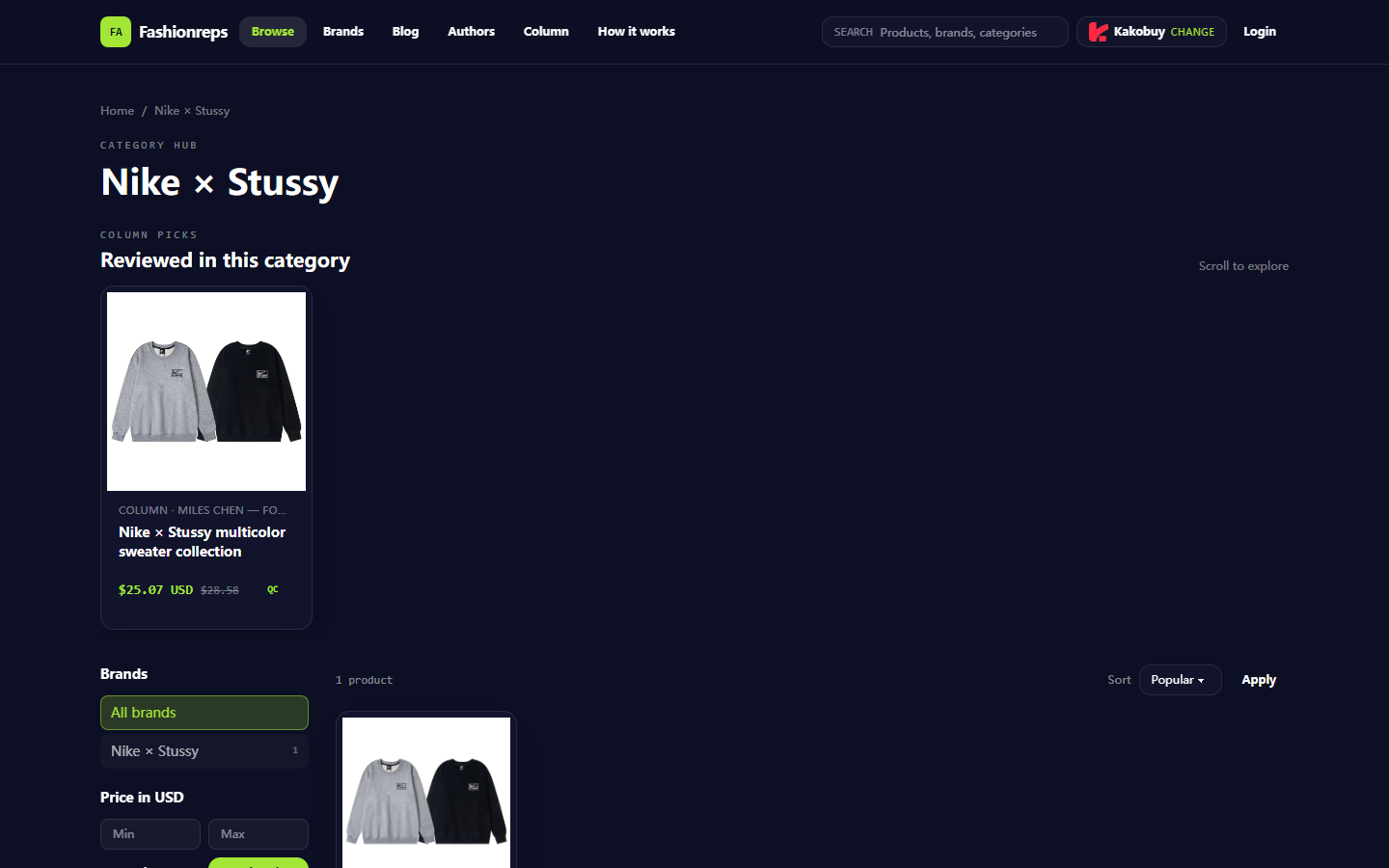
First open the relevant product page and record the actually displayed product name, size, color, selectable quantity, page price, inventory notices, and update time. The relevant category pages on Fashionreps display a collection of Nike × Stussy hoodies and reference price information, but the reference prices on the pages do not equate to the final amount due for the current order, and cannot alone prove that a particular size is in stock.
It is recommended to save the following in your order record:
- The full name and variant displayed on the product page
- The selected size, color, and quantity
- The currency of the page price
- Whether the page notes promotions, reference prices, or historical prices
- Whether the page clearly states inventory, pre-sale, or waiting to ship
- Verification date and time zone
If the page only has a category name without corresponding size, material, seller, or purchasable status, it cannot be considered complete product evidence sufficient to support payment. Images can help confirm the page theme but cannot replace text specifications, actual inventory, or warehouse inspection.
Distinguish Between Item Costs, Service Fees, and Payment Fees
Costs should be recorded separately by the stage at which they occur, to avoid mistaking the shopping agent's item amount for the total package cost.
Item costs typically include the item unit price, price differences for different sizes or colors, and any applicable promotional adjustments. Service fees may come from purchasing agent, warehousing, inbound, inspection, repackaging, consolidation, or outbound processing. Payment fees may be related to the payment channel, currency conversion, bank card, or e-wallet, and whether they are incurred and how they are calculated must be based on the actual payment page and service provider terms.
A verifiable cost record should at least retain:
- Item amount and currency
- The actual quantity selected in the order
- Service fee name, calculation method, and applicable conditions
- The exchange rate or handling fee shown on the payment page
- A screenshot or order record corresponding to each amount
- Which items have not yet been incurred and which have been paid
Do not treat "no service fee," "free shipping," or "low-cost line" as a complete conclusion. They may only apply to specific order amounts, regions, times, lines, or promotional conditions. 💳
Record Packaging Method, Chargeable Weight, and Dimension Conditions
Fall/winter hoodies typically take up more space than thin tops. Before consolidation, confirm whether the warehouse keeps the original packaging, removes excess shoe boxes or outer packaging, uses waterproof bags, and whether these processes incur fees or affect package dimensions.
You need to record the actual weight and volumetric weight separately. Different lines may use different billing rules, and the final chargeable weight may be the higher of the two, or may follow an independent formula for the line. Without warehouse-measured weight and dimensions, you should not prematurely promise that consolidation will definitely be cheaper.
It is recommended to confirm with the warehouse:
- The measured weight of each item after arrival
- The total actual weight after consolidation
- The length, width, and height after consolidation
- Whether volumetric weight is calculated
- Whether there is a minimum chargeable weight or first weight rule
- Whether there are oversize, overweight, or special packaging restrictions
- Whether removing original packaging affects returns/exchanges or inspection
If you only use the estimated weight from the product page to calculate shipping, the result can only be treated as a pending confirmation record, not a final quote. 📦
Use the Official Calculator to Verify Destination Routes and Shipping Costs
Shipping costs must be verified in conjunction with the destination country, postal code or region, package weight, dimensions, declaration information, route availability, and query time. The same number of hoodies may result in completely different final quotes due to packaging method, destination, and route.
Before payment, you can proceed in the following order:
- Confirm the receiving country, region, and postal code.
- Select the actually available logistics route, not just the route name.
- Enter the weight and dimensions provided by the warehouse, not page estimates.
- Check chargeable weight, surcharges, fuel or remote area fee notices.
- Record the currency, quote time, and validity conditions returned by the calculator.
- Compare the calculation result with the final quote on the outbound page again.
If the official calculator requires login or is only available after warehouse outbound, mark the shipping cost as "unconfirmed" and do not substitute another order's price for the current package quote. Query results may also become invalid due to temporary route closures, carrier rule changes, or destination restrictions. 🌍
Check Exchange Rate Dates, Taxes, and Restriction Conditions
If item prices, service fees, and shipping costs use different currencies, record the exchange rate source and date used for each conversion. The actual amount charged by the bank card or payment platform may differ from the page estimate and may include cross-border transaction fees.
Destination country taxes and customs clearance responsibilities should also be verified separately. Attention should be paid to declaration requirements, import restrictions, textile or brand-related regulations, recipient information requirements, and whether the carrier collects taxes on behalf. Do not reduce costs through under-declaration, order splitting to avoid taxes, or evading inspections; declaration information should be truthful, complete, and follow destination country and carrier requirements.
When there are no clear tax rates, exemption thresholds, or route terms, you can record "taxes may apply" but cannot provide a definite amount. Whether taxes are incurred, who collects them, and when they are paid should be based on the latest notices from the destination country's authorities, the carrier, or the logistics service page.
How to Build a Pending Confirmation List When Real-Time Data Is Missing
When the page does not show complete inventory, or the warehouse has not completed weighing and photographing, the safest approach is to first create a phased checklist rather than guessing a total price.
Pre-payment checklist:
- Item name, size, color, and quantity confirmed
- Currency of item page price and verification date recorded
- Applicable rules for agent service fees and payment fees reviewed
- Destination country, region, and postal code confirmed
- Available routes and restrictions viewed
Post-arrival checklist:
- Physical item matches order specifications
- Warehouse photos and inspection information sufficient to judge obvious issues
- Measured weight of each item recorded
- Post-consolidation dimensions and packaging method confirmed
- Decision made on whether to keep or remove original packaging
Pre-outbound checklist:
- Logistics calculator quote matches outbound page
- Chargeable weight and surcharges verified
- Exchange rate and actual payment amount verified
- Declaration information consistent with reality
- Returns, loss, damage, and route restrictions understood
The value of this list is to clearly mark unknown items. Unknown amounts cannot be written as zero, nor can other buyers' package experiences be substituted for current order data.
When Incomplete Information Should Pause Payment
In the following situations, it is recommended to pause final payment or outbound confirmation first:
- The product page lacks a clear name, size, or current purchasable status
- The price only shows a reference value without explaining applicable conditions
- The calculation method of the agent service fee cannot be confirmed
- The warehouse has not yet provided weight or packaging dimensions
- The destination route does not clearly state availability
- The calculator result lacks currency, time, or validity conditions
- Possible taxes, surcharges, or remote area fees are not explained
- The amounts on the order page and logistics page do not correspond
- The page requests personal, payment, or receiving information beyond what is necessary
Pausing payment is not refusing to purchase, but waiting for facts that affect total cost to become verifiable. If customer service can only say "usually about the same" or "we'll see later," keep that item as unconfirmed rather than estimating it yourself. ⏸️
Final Total Cost Review Steps Before Placing the Order
Finally, you can break the total cost into six parts for item-by-item checking: item costs, service fees, payment fees, packaging fees, international shipping, and possible taxes or customs fees. Only when the first five items have corresponding page or order evidence and tax liability is clear is it appropriate to make a final comparison.
Whether consolidation saves money should be calculated using the current package's measured data. It may reduce duplicate first weights or some handling costs, but it may also increase costs due to volumetric weight, package value, route restrictions, or single-shipment loss risk. Splitting packages may incur more fixed fees but may be more appropriate in terms of route restrictions, weight limits, or risk distribution.
Therefore, before payment, write a clear conclusion:
- Expected savings: only fill in amounts supported by existing quotes or calculation results; do not fill in specific numbers without evidence.
- New risks: including volumetric weight increase, higher single-package value, route restrictions, tax uncertainty, and concentrated loss/damage risk.
- Suitable for: buyers who have confirmed inbound data for multiple items, have available destination routes, and can accept single-package risk.
- Not recommended when: item stock unconfirmed, packaging dimensions unknown, route restrictions unresolved, or chargeable weight after consolidation may increase significantly.
If any key cost still relies on guessing, save the product page, order page, warehouse data, and calculator results first, and decide after real-time information is completed. This yields not a seemingly precise but unverifiable total, but an order record that can explain every cost, every restriction, and the next action.