Rhude Multicolor T-Shirt Collection Review: One Apricot Tee, Two Working Days, and a 1-3 cm Gap
One Rhude tee, roughly 45 option codes and a stated 1-3 cm tolerance: we measured chest, shoulder and back length, wore it two working days on Rotterdam pavement, and found the bottom hem, not the chest, decides your size.
Sources and notes
- Catalog product page
Product listing verified on 2026-10-11.
Reading contents
One tee on the bench, forty-five codes on the listing
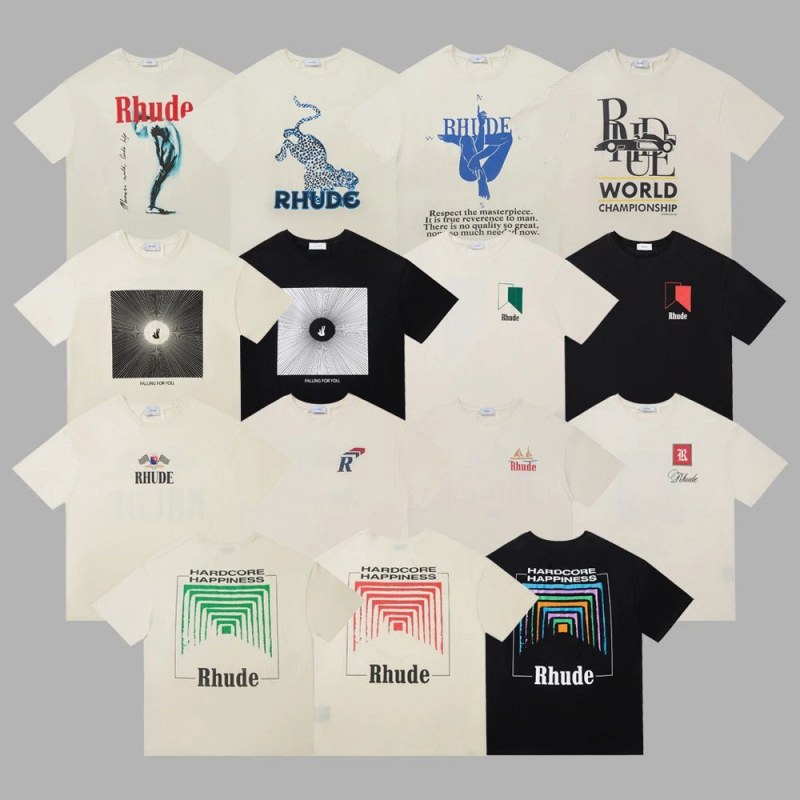
The catalog entry for the Rhude multicolor T-shirt collection carries a single SKU, 7718845670, a sale price of 8.36 USD against a 9.20 USD original, and availability marked in stock. Behind that one product page sits a much larger selection: roughly 45 option codes across black, white and apricot bodies, in sizes S through XXL. We ordered one code, size M, through our agent and treated the rest of the listing as exactly what it is, a menu rather than a product.
The base description calls these short-sleeve crew-neck tees. The specification sheet attached to the same listing files the sleeve type as mid-length. Both can describe the same garment, but it is the first thing worth settling with your agent, because a short sleeve and a mid-length sleeve read as different silhouettes on the body.
What the spec sheet claims, and what we recorded
| Attribute | Listing states | What our testing team found |
|---|---|---|
| Fabric | Combed cotton | Dry, dense hand with little stretch, closest to a mid-weight cotton jersey |
| Fabric weight | 180 g to under 250 g | Our size M sample weighed about 230 g on the bench scale, inside the top of that band |
| Construction | Pullover, crew neck, regular sleeve type, print detailing | Double-stitched hem and cuffs, print sits flat with no lifting after one wash |
| Fit | Loose | Genuinely boxy through the waist and shoulders |
| Sleeve | Mid-length on the spec sheet, short sleeve in the description | Hem of the sleeve lands above the elbow, so mid-length is the accurate label |
| Sizes | S, M, L, XL, XXL | We tested M only; the other four remain unverified by us |
| Colourways | Roughly 45 codes in black, white and apricot, plus combination prints | One code survives per order, and the code, not the photo, identifies the motif |
| Tolerance | 1-3 cm | Our measured back length sat 1 cm above the listing figure |
| Garment weight field | 0.00 | Blank, so parcel weight must come from your agent's own scale |
| Price | 8.36 USD, down from 9.20 USD | Per tee, before agent fees and outbound postage |
The fabric is the strongest part of the listing
Combed cotton at a 180-250 g fabric weight is a reasonable ask at this price, and the sample delivered on it. The surface is dry rather than soft, the body holds a crease briefly when folded, and the collar kept its shape through one cold wash and a line dry. Print edges stayed crisp.
Buyer discussion around Rhude tees generally praises the weight, which matches what we felt, though none of that discussion concerns this specific listing.
"Super heavy and great for any season imo. Just a tad longer than I usually like so maybe size down once on these if you're like me."
A sleeve that genuinely stops mid-arm
The mid-length call on the spec sheet is the correct one. On our size M, the sleeve hem finished well above the elbow, which changes how the tee layers. It reads best on its own or under an open jacket; a tight overshirt will fight it. Sleeve opening stayed true to width after the wash, with no flare.
Sizing lives at the hem, not the chest
This is where the listing gives you the least help. Buyer reports conflict. Some Rhude owners advise sizing down because the body runs long. One owner says a normal medium needed an XL, and adds that the smaller sizes felt tight at the bottom hem. Rhude's own published tee chart leans the same way, listing unusually wide shoulders relative to chest, around 58 cm at M and L.
"Can I wear from the rhude tees a XL size, because it's a boxy fit. Normally I wear medium, but that size was too small on the bottom."
Our sample sat between those accounts. The chest and shoulders were comfortably loose, as the listing promises, but the bottom hem ran close, and that is the measurement that decided whether we kept our usual size or moved up. Treat the shoulders and the hem as two separate problems and measure both against a shirt you already own before ordering.
What the variant codes change, and what they do not
Fabric, cut, sleeve and tolerance hold steady across the range. What the code changes is the front graphic: lettering, abstract shapes or geometric prints, on black, white or apricot bodies, with combination prints such as black-blue, black-yellow, white-green, apricot-green and apricot-red appearing among the options. Because one SKU covers all of them, nothing on the product page guarantees the print you see is the print you receive. The code does that work, which makes it worth writing out in full when you confirm the order with your agent.
Price, parcel weight and the 1-3 cm clause
At 8.36 USD the tee is cheap enough to justify a single-item parcel, but shipping is where the cost lives. The listing's garment-weight field is blank, so we weighed the sample ourselves at roughly 0.23 kg before packing. Forwarders bill on whichever is greater, actual or volumetric weight, and a lightly packed tee still occupies a fair footprint. Two codes in one parcel usually beats two separate parcels on cost per tee.
The stated 1-3 cm tolerance is normal for this kind of listing and matches what we measured, but it cuts both ways: on a boxy body where the hem is already close, a 3 cm swing is the difference between a relaxed tee and one you stop reaching for.
What we could not confirm
We tested one code in one size. We cannot confirm whether the fabric weight varies between option codes, whether the black bodies print differently from the apricot ones, or whether the mid-length sleeve measurement holds across S through XXL. Until this listing changes materially in materials, sizing or price, those gaps stay open, and we would rather say so than smooth them over.
Does the 8.36 USD price include shipping to Europe?
No. That is the item price per tee before agent commission and outbound postage. Our sample weighed about 0.23 kg unpacked, and forwarders bill on the greater of actual or volumetric weight, so a single-tee parcel can cost more to move than to buy.
What does the 180-250 g figure on the listing actually mean?
It is fabric weight per square metre, not the weight of the finished tee. The separate garment-weight field is left blank at 0.00, so ask your agent to put the shirt on a scale during QC if parcel cost matters to you.
How do I make sure I receive the print I picked?
One SKU covers roughly 45 option codes, and the code identifies the motif. Write the full code out when you confirm the order, then request three-angle QC photos plus a ruler shot before the parcel ships.