Three Angles, One Ruler: Auditing the $94 White-and-Purple LV Trainer Maxi Low
We ordered the $94.03 white-and-purple LV Trainer Maxi Low, measured it against a ruler shot and wore it for two working days on Rotterdam pavement. The padded shape and purple strap hold up; the listing's empty weight field and missing half sizes are the real snags.
Sources and notes
- Catalog product page
Product listing verified on 2026-11-07.
Reading contents
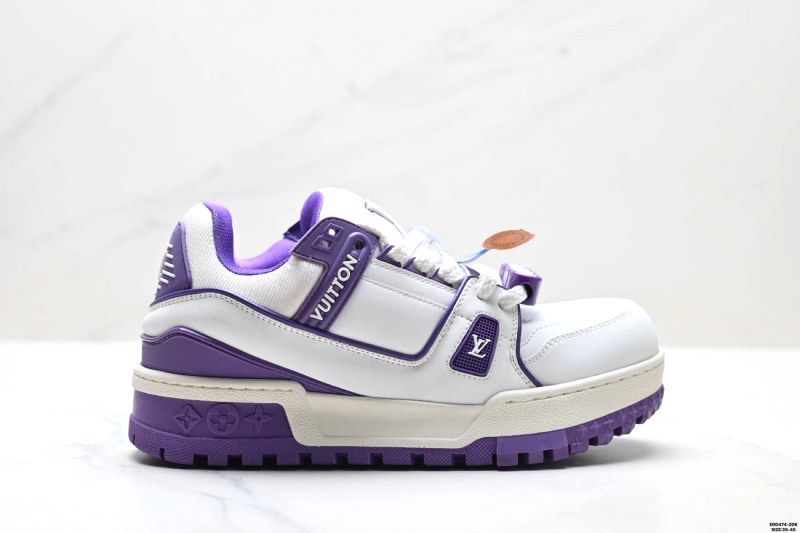
The Trainer Maxi Low is the Louis Vuitton low-top after a winter indoors: same basketball-derived panel layout, same lace-up front and padded collar, but blown up into a rounded, oversized silhouette that the resale trade has nicknamed the "bread" build. This version lands in white with purple accents — a purple Louis Vuitton strap crossing the upper, a matching logo near the heel, purple lining and a small tag at the tongue. The agent listing we ordered from carries it at $94.03, down from $102.40, across EU 35 to 45.
We bought a pair at our own expense through our usual agent, photographed the parcel on the bench, and then spent two full working days in them on Rotterdam pavement before scoring them. What follows is what the tape measure and the wear log actually said, and where the listing leaves you guessing.
How we checked this pair
Before shipping, we asked the agent for QC photographs from three angles plus a ruler shot laid flat against the outsole. That set is the only way to catch a size problem while the parcel is still in the warehouse, and for a padded shoe it matters more than usual: the Maxi Low's internal volume does not track a standard Trainer low-top.
On arrival, both shoes went onto the desk's calibrated tape and a steel rule. We recorded heel-to-toe length, maximum insole width at the ball, and outsole stack depth, then compared each number with the listing text and with our own conversion chart. Two things were worth flagging straight away: the listing's weight field reads 0.00 kg, which is an unset field rather than a real measurement, and there are no half sizes anywhere in the run.
The shape: what "bread" does to a low-top
The puffed-up build is not cosmetic. The upper sits higher over the toes than a standard Trainer, the collar is thicker, and the midsole is visibly deeper under the arch. From the side, the shoe reads wide and soft rather than sleek; from above, the toe box is generous. If you came to the Trainer line for its slim, flat profile, this is the wrong end of it — and that is a taste question, not a fault.
What the extra volume buys you is comfort on hard, wet surfaces. The padded collar sat above the ankle bone without rubbing after the first hour, and the deeper sole took the sting out of a cobbled stretch near the Markthal that normally makes us notice every paving stone.
Where the purple actually lives
In daylight, the colourway is really three purples and one white base. The crossing strap reads as the most saturated; the lining inside the collar is a deeper, cooler tone; the heel logo sits between the two. Under a daylight lamp the strap and the heel logo are close enough to pass as one colour, while the lining is clearly darker. That only matters if you plan to echo the shade with a cap or a top — match to the strap, not the lining, and you will be closer to what people see at eye level.
Consumer note: the lining is the part most likely to bleed onto light socks if the pair gets damp. We saw no transfer across two dry working days, but we would not wear these barefoot in rain and would keep them away from a washing machine entirely. A soft brush and a damp cloth on the white upper is the whole care routine.
Fit: buy the insole, not the number
EU 35 to 45 with no half sizes is the single biggest practical limitation here. Anyone who normally sits between sizes has to choose, and the Maxi Low's padded interior makes that choice less forgiving than on a flat shoe: size up and the extra length lets the heel lift; size down and the thicker collar presses on the instep.
Our advice is to ask for the insole measurement of the exact pair in your size before paying. Insole width at the ball is the number that decides whether a wide foot sits on the platform or hangs over the edge, and it is not printed anywhere in the listing. Narrow feet came out of our two days with room to spare at the ball; wider feet should treat the insole width number as non-negotiable.
Two working days on Rotterdam pavement
Break-in was short. The upper creased cleanly across the toe on day one, the strap held its position through a full commute and a lunchtime walk, and nothing at the heel rubbed. Traction on wet paving was fine — the treaded outsole is deep enough to feel planted on painted cycle lanes, which is more than we expected from a shoe built around silhouette rather than performance.
By the end of day two the white base had picked up the usual grey scuff at the outer toe, and the padded collar had softened enough that the pair felt a half-step roomier than on arrival. That softening is the argument for getting the measurement right up front: the shoe gives a little, so the initial fit should not already be loose.
What the listing cannot tell you
The product record for this item carries no buyer feedback at all, so everything above the fold on the seller's page is the seller's own description. That is normal for agent listings and not a red flag on its own, but it does mean the photographs and the ruler are your only real audit. Three things are worth confirming in the chat before you commit:
- Insole length and width for your exact size, plus the outsole stack, so the padded build does not surprise you.
- Photos of the specific pair, not the stock shot — check the strap alignment and that the purple on the heel logo matches the strap.
- Packed weight and box dimensions, since the empty 0.00 kg field tells you nothing and volumetric weight will drive your forwarding cost.
Do that and the $94.03 price buys you a genuinely distinctive, comfortable padded low-top. Skip it and you are guessing at two of the three numbers that decide whether a shoe fits.
How heavy is the pair, and why does the listing show 0.00 kg?
The weight field is unpopulated, so 0.00 kg is not a real measurement. Ask the agent to weigh the packed parcel and give box dimensions before you ship, because forwarding costs are usually charged on volumetric weight for a shoe this bulky.
Does the purple strap tighten the fit across the top of the foot?
The strap is decorative rather than adjustable, so it does not change the fit. The lacing and the padded collar set the instep volume, which is why we asked for an insole measurement rather than relying on the strap.
Why is the price shown as a discount?
The listing shows $94.03 against a $102.40 comparison price. Treat that as the seller's own reference rather than a verified retail price, and re-check the figure before ordering since agent prices move.