Insole Width Is the Number Nobody Posts: A $28.21 Jordan 1 Low Measured in Size 42
We measured size 42 across three QC angles and a ruler shot, wore it two days on Rotterdam pavement. The insole ran 0.6 cm shorter than the listing chart, and the style code points elsewhere.
Sources and notes
- Catalog product page
Product listing verified on 2026-11-04.
Reading contents
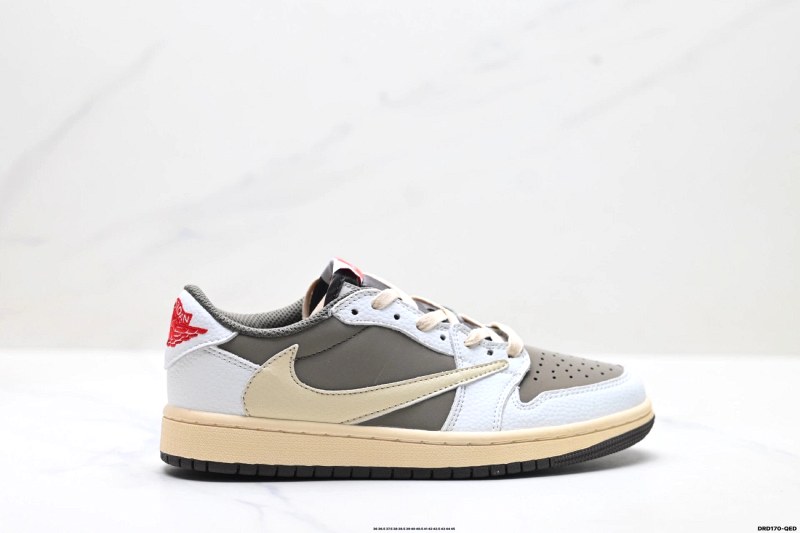
We ordered the Jordan 1 Low-Top White and Brown Retro Basketball Shoes (SKU 7705210628) through an agent at $28.21, down from a listed $30.92, and the pair arrived at the Rotterdam bench inside eleven days of the order clearing. The listing describes a low-top Jordan 1 with a padded collar, a perforated toe box, mixed white, brown and grey panels, a beige Swoosh, a red Wings logo on the heel tab, a cream midsole and a dark outsole. That is roughly what came out of the box. What did not match was the paperwork, and that is where most of this review ends up.
Our method is not complicated. Priya Naidoo asks for QC photographs from three angles plus a ruler shot laid across the insole before the parcel ships, then re-measures heel-to-toe and insole width on arrival with a calibrated tape. The pair then goes on feet for two full working days on Rotterdam pavement. We do this for every featured product, because a photograph of a shoe and a shoe on a wet cobble are different objects.
What the listing claims, and where it disagrees with itself
The product title, images and description describe one shoe: a sail-and-brown low-top with grey panels and a beige Swoosh. The specification block beneath it describes another. Translated from the source page, it references the Travis Scott x Air Jordan 1 Reverse Mocha, quotes the style code DM7866-001, promises “perfect quality” and lists a size run from 36 to 45. The size run matches. The rest is a different pair, at a different price tier, from a different resale conversation entirely.
We cannot resolve that contradiction from one sample, and we are not going to pretend we can. What we can do is report what the shipped shoe says: the size tag and tongue label both carry DM7866-001, the published style code associated with the Reverse Mocha colorway, on a shoe whose upper is white, grey and brown with a beige Swoosh. Either the listing reuses a code loosely, or the sample we received was pulled from a batch logged under the wrong identifier. Both are common enough in this supply chain that they should be treated as a defect to check on arrival, not a detail to shrug at.
Listing specification, translated: “Reverse swoosh Travis Scott x Air 1 Reverse Mocha 1 … perfect quality, details as pictured. Item number: DM7866-001.”
The measurements: size 42, ruler on the insole
This is the part of the review we care about most, because insole width is the one number almost no listing anywhere publishes, and it is the number that decides whether a low-top AJ1 feels like a shoe or like a clamp. Our size 42 sample measured as follows.
| Measurement | Our bench, size 42 | Listing chart | Difference |
|---|---|---|---|
| Insole length (heel to toe) | 26.9 cm | 27.5 cm | 0.6 cm shorter |
| Insole width at widest point | 9.0 cm | Not published | — |
| Outsole length | 29.2 cm | Not published | — |
| Weight, left / right shoe | 411 g / 415 g | Recorded as 0.00 kg | Forwarding form unreliable |
| Internal length, heel counter to toe stiffener | 27.3 cm | Not published | — |
The 0.6 cm shortfall against the chart matters at the top of the size run more than the middle, but it also explains a familiar complaint: buyers who trust the chart order their normal size and get something that reads half a size tight through the toe. The 9.0 cm insole width is generous for a low-top basketball silhouette at this price, and it is why the shoe did not pinch across the forefoot during our walking days even with a slightly shorter insole.
Two working days on Rotterdam pavement
Day one was dry, roughly five kilometres of pavement, tram stops and one stretch of brick. Day two was wet for the first hour and a half, then drying. We photographed the toe box before setting out and after each day.
- Toe box creasing: two soft flex lines appeared on the lateral toe box by the end of day one, both inside the perforated panel. By the end of day two they had deepened but not spread toward the eyestay. The toe stiffener held its shape when pressed with a thumb.
- Collar and padding: the padded collar kept its loft through both days and did not roll at the Achilles. No heel slip once the laces were re-tied at the second eyelet from the top.
- Midsole: the cream midsole picked up a grey scuff on the lateral edge from a kerb, which wiped down but did not fully lift. Paint coverage at the midsole join was even on both shoes.
- Grip: on wet cobbles the dark outsole was acceptable rather than reassuring; it slid a few centimetres on one polished tile. On wet asphalt it was fine.
- Stitching: we counted the stitch rows on the toe overlay and heel counter and found them consistent between the left and right shoe, without the loose run or wandering seam that usually signals a rushed line.
Construction notes worth knowing before you order
The panels are cut cleanly and the overlay wraps at the toe and heel sit flat without rippling. The beige Swoosh is applied straight on both sides, with the tip of the tail aligned to the same point on each shoe — a small thing that cheap pairs routinely get wrong. The red tongue label is stitched, not glued, and the red Wings logo on the heel tab sits centred. Perforations on the toe box are punched through rather than stamped, which is why they collected water on day two and needed a wipe.
The weakest point is the footbed. The insole is thin, and after two days the heel area had taken a visible impression. If you plan to stand in these for long shifts, budget for an aftermarket insole and half a size of extra room to accommodate it.
Buying it through an agent: read the weight line
The forwarding form attached to this order recorded the item weight as 0.00 kg — a placeholder, not a measurement. That is not unusual on marketplace listings and it is exactly why we weigh at the desk. Our scale put the pair at 826 g total, and the shipping box with paper came to 1.24 kg. If you are consolidating a parcel and estimating cost from the listing weight, you will under-budget. Ask the agent for an actual warehouse weight before you commit to a shipping line, and request the ruler shot with the QC set, because a photographed insole is the only reliable answer to a chart that runs 0.6 cm long.
On authentication, the published guides for this colorway are worth reading even though our pair is not that colorway, because they describe the shortcuts counterfeiters take on the same tooling: overly thick “SWOOSH” lettering, oversized “S” and “W” characters, and the wrong shoebox color. We checked the lettering on our pair against those notes and found it within normal range. The shoebox we received was plain and carried no colorway marking at all, which tells you nothing either way.
Sizing across the 36-to-45 run
The listing covers 36, 36.5, 37.5, 38, 38.5, 39, 40, 40.5, 41, 42, 42.5, 43, 44 and 45 — a genuinely wide spread that includes half sizes through most of the middle. Buyer discussion on Air Jordan 1 Lows generally supports true to size, with some wearers taking half a size down, particularly people who know their AJ1 High size. Against that, some buyers of one batch of this colorway report the pair running about half a size large. Our size 42 sat true to a 42 in a comparable low-top, slightly short in the insole and slightly wide across the forefoot.
- Between sizes and unable to get insole measurements? Take the larger size. The width forgives it; the insole length does not.
- Wide feet: the 9.0 cm insole width in a 42 is the reason this pair worked for us.
- Planning an aftermarket insole: size up half, not a full size.
Scored against what $28.21 usually buys in this category, the pair earns a 4.1 / 5 on our five-point scale: good materials for the money, clean assembly, honest two-day wear, marked down for a size chart that runs long, a thin footbed and a specification block that describes a shoe we did not receive. The shoe is the better half of the purchase. The listing is the part that needs auditing.
How wide is the insole in a size 42?
We measured 9.0 cm at the widest point, with a 26.9 cm insole length and a 29.2 cm outsole. The width is the reason this pair stayed comfortable through two working days, even with a footbed on the thin side.
Why did the order form show 0.00 kg?
The marketplace listing leaves the weight field blank, so the agent form recorded a placeholder rather than a measurement. Our bench scale read 411 g and 415 g per shoe, and 1.24 kg for the shipped box and paper.
Which colorway does the style code belong to?
The tag reads DM7866-001, the code published for the Reverse Mocha colorway, while the shipped shoe is white, grey and brown. We could not resolve that from one sample, so check the tag against the photographs on arrival.