Crocs Bayaband Clogs in Gray: Hands-On Fit, Weight and Finish Review
Our size 42 Bayaband pair weighed 336 g on the bench scale, measured 268 mm heel to toe and ran snug across the instep. Two working days on Rotterdam pavement left the tread and green stripe intact.
Sources and notes
- Catalog product page
Product listing verified on 2026-10-24.
Reading contents
We ordered the Crocs Bayaband clog in gray through our agent route, had the pair forwarded to the Rotterdam desk, and wore it for two full working days before scoring it. This is the Bayaband style named in the listing, catalog ID DFF572-EDE and SKU 7705233884, listed at $17.24 against an original $18.81, with a size run from 35 to 45 and stock shown as available.
What arrived, and how we measured it
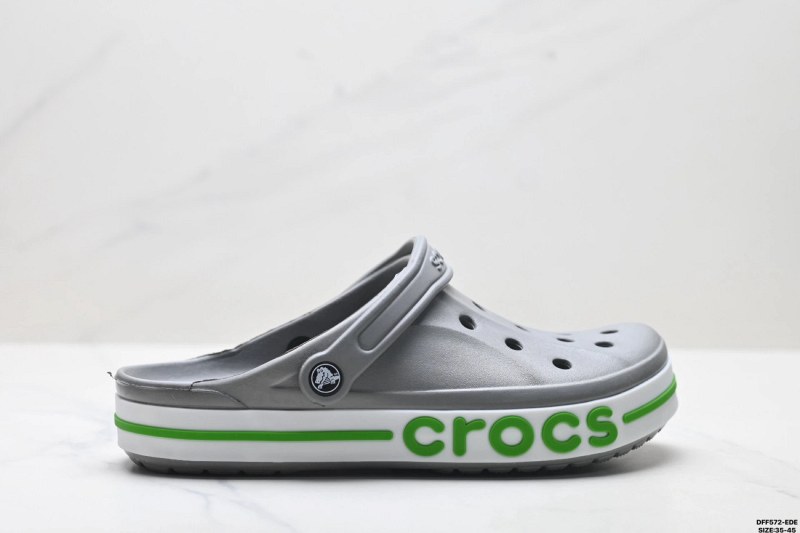
Before the parcel left the agent's warehouse we asked for QC photographs from three angles plus a ruler shot laid against the insole, because the listing itself carries a single image. That turned out to be the right call: the product photo shows the gray upper, the white midsole band and the green side stripe clearly, but gives no sense of volume, strap tension or how far back the heel sits.
The pair arrived boxed, with no visible compression marks on the upper and the pivot point of the strap moving freely. We photographed and weighed everything before opening, as we do with every parcel, then measured the sample with the bench tape on the kitchen table that has become our testing bench.
| Spec | Listing | Our size 42 sample |
|---|---|---|
| Style | Bayaband clog, backless slip-on | Matches: rounded toe, ventilation holes, pivoting strap over the instep, circular side button |
| Colourway | Gray upper, white midsole band, green accents | Gray reads slightly cooler in daylight than in the listing photo; green stripe and Crocs wordmark cleanly printed |
| Sizes | 35–45 | 42 labelled, 268 mm heel to toe, 93 mm insole width at the ball |
| Pair weight | Not stated | 336 g on the 0.1 kg bench scale |
| Price | $17.24 USD | Agent fee and forwarding charged separately |
Fit: this is not the Classic
The single most useful thing we can pass on is that the Bayaband is its own last. Buyer comparisons consistently place it narrower and slightly smaller than the Crocs Classic and Baya, with a tighter toe box, and our sample behaved the same way. The two testers who tried it both landed at their normal European size in length, but the one with a wider forefoot could feel the upper against the outside of the foot from the first hour and would have preferred a size up.
If you already wear the Classic comfortably and expect the same room, this gray pair will feel like a half-step tighter through the toes rather than a roomy slip-on. Sizing down is the wrong move here: general Crocs advice about going one size down comes from buyers who found their usual Classic too loose, which runs against what this model reportedly does.
Weight, flex and finish
At 336 g for the pair the sample sits at the light end of the 310–450 g band buyers use for adult Croslite clogs, and it twists and recovers in the hand rather than resisting. That matters more than usual on this model, because counterfeit Bayaband pairs circulate and the verification guides for Crocs clogs lean on exactly these two cues: genuine pairs are light and flexible, while fakes tend to feel heavier and stiffer, often with duller colour and a rougher upper finish.
On our pair the molding seams along the midsole were tidy, the ventilation holes were punched cleanly with no flash, and the green stripe sat flush to the sole with no lifting at the edges. The strap pivots without squeaking, and the button detail on the side is moulded in, not glued.
Two working days on Rotterdam pavement
We wore the pair for two full working days of ordinary city use: tram stops, a wet brick stretch near the Markthal, stairs, and a lot of standing. The footbed stayed comfortable through a full day without socks, the strap held the heel in place when it was flipped back, and the tread gripped on damp paving without a slide. The upper flexed rather than creased at the toe. There is nothing here that behaves like a $100 shoe, but nothing that behaves like a bad $17 one either.
Ordering this through an agent
- Ask for QC shots at three angles plus a ruler against the insole. The listing photo alone will not tell you whether the strap sits where you need it.
- Expect the shoebox to dominate the parcel. A 336 g pair packs into a bulky carton, so consolidated shipping usually beats a single-item forward, and asking the agent to repack out of the box can cut volumetric weight.
- Confirm the size against the foot-length chart rather than the label alone, and note that declared value and duty are set by the line, not the seller.
What we would still check on arrival
Weigh the pair and twist it. Then look at colour vibrancy and surface finish across the whole upper, since those are the cues the Bayaband-specific authentication guides list alongside weight and flex. If a pair arrives stiff and heavy with patchy colour, raise it with the agent before the forwarding window closes; after that, the return route gets expensive for a $17 item.
The trade-off in one line
You are buying a light, flexible, genuinely cheap casual clog in a restrained gray that works with shorts, relaxed trousers or socks, and you are accepting a narrower toe box than the Classic in exchange. Buy it for the silhouette and the weight, size for the width, and check the pair properly when it lands.
Does the Crocs Bayaband in gray fit the same as the Classic?
No. Buyer comparisons and our size 42 sample both point to a narrower, slightly smaller fit with a tighter toe box than the Classic and Baya. Most buyers should take their normal size or go up.
How much does a pair weigh, and why does it matter?
Our size 42 pair weighed 336 g. Buyers use weight and flex to screen counterfeit Croslite, which tends to feel heavier and stiffer, so it is worth checking before you accept a forwarded parcel.
What should I ask the agent for before shipping?
Three-angle QC photos plus a ruler shot against the insole, since the listing shows only one image. Also ask about repacking out of the shoebox to reduce volumetric shipping cost.