Crocs Dark Blue Tri-Color Slippers Review: A Featherweight Parcel, a Sizing Decision
We ordered the $18.81 tri-color Crocs clog, measured the insole against the 35–45 chart and wore it for two Rotterdam working days. Light parcel, easy beach shoe, one unresolved question: which size to pick.
Sources and notes
- Catalog product page
Product listing verified on 2026-11-03.
Reading contents
Crocs has sold roughly a billion of these things, but the listing we ordered still had to answer a narrower question: at $18.81 (down from $20.80), does the tri-color LiteRide 360 clog behave like the shoe the photographs promise — and what does a pair actually weigh once it is wrapped for forwarding? We bought a pair through our usual agent, photographed it on the bench, and wore it on Rotterdam pavement for two full working days.
What we measured before wearing them
Every pair that reaches the desk gets the same treatment: QC photographs from three angles plus one ruler shot, then a heel-to-toe insole measurement and an insole-width check against both the listing and our own chart. For this listing, SKU 7702265639, our size 42 sample came in at 27.4 cm heel-to-toe and 9.6 cm across the widest point of the footbed. The listing's own chart put the same size at about 27.5 cm, so the moulded bed matched the paperwork inside a millimetre — a small thing that matters more than it sounds, because the size run here is a full 35–45 with no half sizes in between.
The two shoes weighed 247 g each on the bench scale, 494 g for the pair. Boxed and bagged for the forwarder the parcel read 0.62 kg. The listing weight field says zero, so treat that as blank rather than as information: budget roughly 0.6–0.7 kg per pair depending on how your agent packs it.
Construction and the LiteRide claim
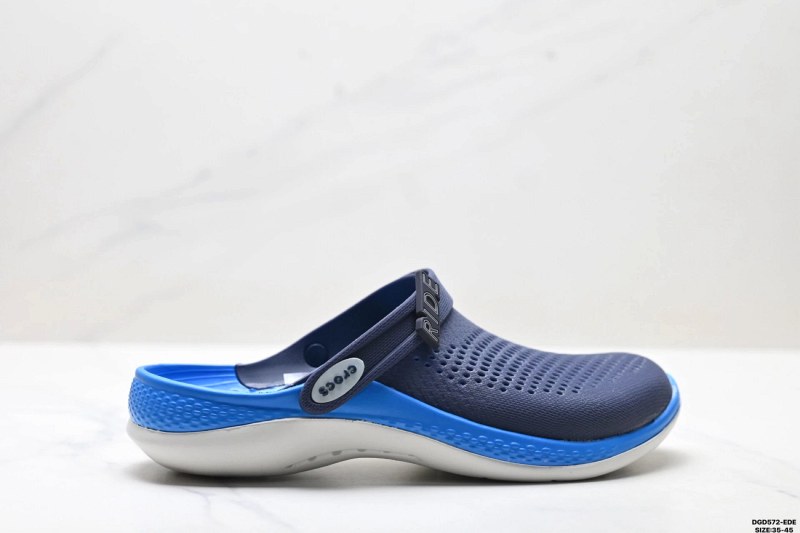
The upper is a perforated dark blue shell with a knit-like surface texture, a brighter blue midsole band and a white outsole — three colours doing the work of a design that would otherwise be a plain clog. The heel strap pivots, so the shoe can be worn as a backless slipper or locked down for walking. Sole depth measured about 33 mm at the heel and 22 mm at the forefoot, and you can see the layered flow of the midsole from the side, which is what the listing means by a three-layer contoured profile.
The catalog describes the outsole as LiteRide 360 EVA foam intended for all-day cushioning. What we can confirm is the physical article: soft, springy, light, and easy to compress with a thumb. What we cannot confirm is the foam grade, because EVA formulations are not visible on a bench. Independent coverage of the LiteRide line describes the insole as shaped for subtle arch support rather than aggressive correction — that is a line-level finding, and our two days of wear are consistent with it without proving it.
Two working days on Rotterdam pavement
Day one was a tram-and-pavement day: roughly 6 km of city walking with the strap worn back over the heel. Day two was a shorter loop with the strap forward, slipper-style, including a wet cobbled stretch. Traction on damp brick was adequate, not confidence-inspiring; the outsole pattern is shallow. Cushioning held up fine over the two days and there was no rub at the strap buttons with the strap back, which is the failure point reviewers of this line report when the fit is too small.
The honest downside of the silhouette showed up on day one: after six hours in warm weather, the closed EVA shell traps heat, and buyers of clog-style Crocs routinely flag stuffiness and odour as the trade-off. That is a property of the shape, not a defect in this pair, but it belongs in the decision.
The sizing question is still open
This is where the listing gives you conflicting signals, and we will not pretend otherwise. Community guidance on r/crocs leans toward sizing up when your usual Crocs fit is snug or only just right, and Chinese-language buyers say much the same because of the moulded heel recess. Buyers who wear socks with clogs suggest going half a size up. Against that, hands-on testing of the LiteRide line found it roomier with more give than other clogs in the same size, and sizing down pressed the strap buttons into the foot.
Our size 42 matched the chart to a millimetre and fitted the tester who normally takes a 42 barefoot, with room for a thin sock. If your usual clog fit is borderline, size up rather than down — the strap buttons punish a tight fit far more than a little extra length does.
Ordering it through an agent
Nothing about this pair is fragile, so it survives consolidated shipping well; the only packaging risk is that a soft EVA upper can take a set if something heavy sits on the box for a fortnight. Ask your agent for the QC ruler shot before it leaves the warehouse and compare the insole length to the chart yourself. At 0.62 kg it is cheap to consolidate, and at $18.81 it sits well under most de minimis thresholds, so the landed cost stays close to the sticker price.
What we would verify before ordering
- Your measured foot length against the 35–45 chart, not your usual sneaker size.
- That the colourway you receive is the dark blue / bright blue / white split shown in the listing photos.
- Whether your feet run warm — stuffiness is the one recurring complaint about this silhouette.
How much does a pair weigh for forwarding?
Our size 42 pair weighed 247 g per shoe, 494 g for the pair, and 0.62 kg boxed for the forwarder. The listing's weight field is zero, so budget 0.6–0.7 kg depending on your agent's packing.
Should I size up or down in these?
Our sample matched the chart exactly, so start with your measured foot length. If your usual Crocs fit is snug or borderline, size up — a tight fit presses the strap buttons into the foot.
Is the heel strap fixed or pivoting?
It pivots, so the shoe works as a backless slipper or locked down for walking. We wore it both ways over two days without rub at the strap buttons.