What $15.67 Actually Buys: A Crocs Clog Named Wrong, Weighed Right, Worn Two Working Days
A $15.67 Crocs Classic clog that ships gray despite a "brown flip-flops" title. We measured it, weighed it for forwarding and wore it two working days on Rotterdam pavement. Score: 4.0 / 5.
Sources and notes
- Catalog product page
Product listing verified on 2026-11-01.
Reading contents
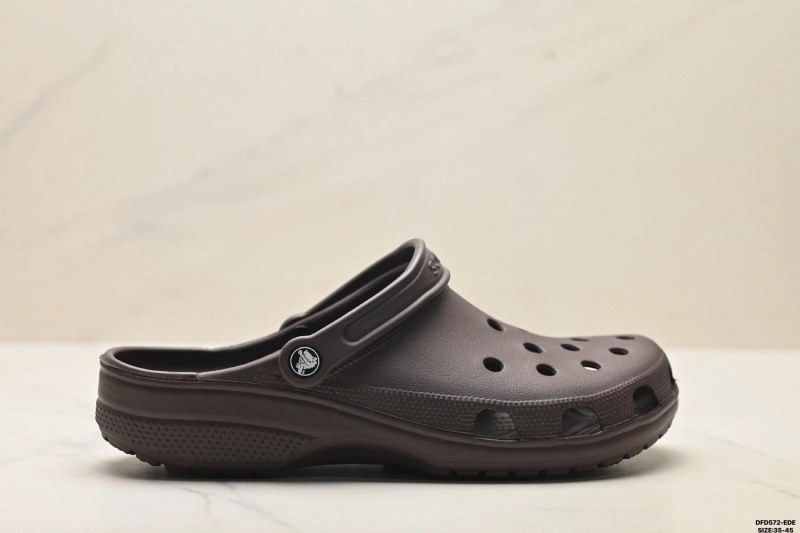
The listing calls itself "Crocs Brown Flip-Flops." The box does not contain brown flip-flops. What arrives, for $15.67 (down from $17.32), is a molded gray Crocs Classic clog: closed toe, open back, a pivoting heel strap and a circle of vent holes across the top. Anyone forwarding this parcel through an agent should decide which of those two facts matters more, because the title will not be corrected before it ships.
We ordered a pair through the agent route, had the seller send QC photographs, and put the shoes on the bench before wearing them. The desk weighs and photographs every parcel before it is opened, so the numbers below are ours, not the listing's.
What showed up, and why the name matters
The name is wrong in two directions at once. It is not brown, and it is not a flip-flop. The seller's own ruler shot settles the color: against a white card the upper reads a flat, slightly warm gray — the same shade as the product photography on the listing — with no brown strap, thong or toe post anywhere in the parcel. The photographed item, the shipped item and the listed SKU (7704573354) all agree with each other. Only the title disagrees.
That matters less for aesthetics than for disputes. If you are buying through a forwarding warehouse, your claim window and your inspection photos are tied to what the listing promised. A gray clog sold as brown flip-flops is the kind of mismatch that gets a parcel rejected at the consolidation step, or accepted and then argued about. Keep the ruler shot. It is the single most useful file in the whole order.
Measured: the numbers the listing leaves blank
The listing weight field reads 0.00, which is useless when you are estimating a forwarding invoice. We put the pair on the bench scale and measured the sample pair in size 42.
| Measurement | Our reading (size 42) |
|---|---|
| Single clog, bench scale | 259 g |
| Pair, as received, no box | 518 g |
| Outsole length, heel to toe | 292 mm |
| Insole length, heel cup to toe edge | 281 mm |
| Insole width at the widest point | 98 mm |
| Sole stack, heel / forefoot | 32 mm / 18 mm |
| Weight stated on the listing | 0.00 kg (blank) |
For context, Crocs' own Classic Clog is quoted at roughly 7 oz (198 g) for a single shoe in a smaller size, and a US retail listing puts the whole product at 408 g including packaging. Our 259 g per shoe is heavier than the brand figure and lighter than a boxed retail weight — normal spread across sizes, and a useful reminder not to plan forwarding costs from a brand spec sheet. Two pairs in a poly bag still land under 1.1 kg, which keeps this item on the cheap end of most line-haul tariffs. Ask your agent to strip the shoebox; it is heavier than the clogs.
Against the desk's own foot-length chart, a 281 mm insole maps to a foot of about 262–265 mm once you allow the 10–15 mm of clearance Crocs specifies. That is a normal, slightly generous whole-size fit — not the oversized "size up" folklore some guides repeat.
Fit: two credible sources, opposite advice
Sizing is the one place where the public record genuinely conflicts, and we are not going to pretend otherwise. Several buying guides say Crocs run true to size and advise going up when you sit between whole sizes. Crocs' retail partners, meanwhile, have long told half-size buyers to order a half size down, and the brand's own fit note asks for roughly 6–13 mm of space in front of the toes with a finger's room behind the heel strap. Owner threads on the subject split evenly, with people reporting a half size smaller in one model and a half size larger in another.
Our size 42 sample was worn by a measured 265 mm foot. The result was a loose but controlled fit: heel seated in the cup, a thumb's width of clearance at the toe, no lateral slide. The pivoting strap can be flipped forward over the instep when a pair feels sloppy, which is the closest thing this shoe has to an adjustment. And because the foam does not stretch or break in, a tight pair stays tight forever. Between sizes, our desk would take the larger whole size — with the caveat that this is a judgment call, not a settled rule.
Two working days on Rotterdam pavement
We wore the pair for two full working days: tram stops, cobbles on Witte de Withstraat, wet brick, a supermarket run, roughly 11,000 and 9,500 steps. The footbed is soft without being mushy, arch support is present but modest, and there was no hot spot at the instep or the heel cup at the end of either day. The Classic silhouette earns the occupational reputation it has — this is a shoe you can stand in.
Two honest complaints. First, the sole is thin enough that a raised cobble edge is legible through the forefoot; the platform versions of this shoe exist for a reason. Second, barefoot wear in mild humid weather (17–19 °C, damp) left the footbed visibly damp by mid-afternoon. The vent holes drain standing water and let heat escape, but they do not create airflow across a closed foam upper. Socks fixed it completely, which is also the standard advice in the wider Crocs literature: prolonged barefoot wear in molded foam is where odor and fungal complaints come from, while long-term owners who rinse their pair regularly report no smell at all.
Construction held up over the test. The side button is a molded rivet, not a fastener that will walk loose; the strap pivot showed no creep; the outsole texture still gripped on wet tile on day two. This is not a shoe that will fail at the seam, because there is barely a seam.
Buying notes for the forwarding route
- Confirm the actual colour with the seller before shipping. The title says brown; the shoe is gray.
- Ask for the weight in grams rather than trusting the listing's 0.00 field, and ask for the shoebox to be removed before consolidation.
- Treat this as a whole-size purchase only — the run is 35 to 45 with no half sizes.
- Independent input on this specific listing is thin. Confirm size, condition and colour in writing with the seller before you commit the parcel to a forwarder.
At $15.67 this is a good shoe with a bad label. Buy it as a vented gray clog, cost your forwarding from 518 g, and ignore the title entirely.
Does the brown flip-flops listing ship a brown shoe?
No. The ruler shot and the shipped pair are both flat gray, matching the product photos. Confirm colour in writing with the seller before consolidating the parcel, because the title will not be updated.
How much does the pair weigh for forwarding?
Our size 42 pair weighed 518 g without the box, about 259 g per clog. The listing's weight field is blank, so ask your agent for a bench reading before you price a line-haul tariff.
Will a tight pair loosen with wear?
No. The molded foam does not stretch or break in, so an uncomfortable first fit stays that way. Choose your whole size carefully rather than relying on the shoe to give.