Burberry Stand-Collar Business T-Shirt Review: A $36.04 Piqué Shirt Measured Against a £355 Burberry Polo
A 196 g piqué shirt with tidy ribbing for $36.04, measured flat and worn for two days. The Burberry attribution and 210 gsm figure stay listing claims; the price sits far below first-party polos.
Sources and notes
- Catalog product page
Product listing verified on 2026-11-13.
Reading contents
Most reviews of a $36 collared shirt come down to one question: is it any good? This one carries a second question. Burberry's own cotton piqué polos sell for £355 in the UK and ₹45,000 in India, and stockists list comparable styles between £390 and roughly $495. A $36.04 shirt trading under the same name is not on the same shelf, so our job at the desk was to measure what arrived rather than argue about the label.
We ordered the white version through an agent, requested QC photographs before consolidation, and logged the parcel at 0.31 kg including packaging. The shirt inside, size M, weighed 196 g on its own. Both figures are ours, taken on the 0.1 kg bench scale we recalibrate each January.
What we asked the agent to photograph
The listing gives no size chart, no fabric composition table and no garment weight; the seller specification field is empty. That pushes the checking work onto the QC step, so our request was specific:
- Three angles: front flat, back flat, and a three-quarter view showing how the collar sits.
- A ruler shot across the chest and down the body length, tape visible in frame.
- Close-ups of the stand collar, the short placket and the embroidered chest motif.
- A readable photograph of the neck label.
Agents publish a free QC set of a few images per item; the ruler shot is a request on top of that set, not a guaranteed inclusion, and turnaround depends on warehouse load. Assume you may have to approve the parcel on standard photos alone.
The cloth, and what a ruler can and cannot prove
The seller describes 210 g cotton piqué, same-vat dyeing, imported-yarn ribbing at the collar and cuffs, and Barudan embroidery machines. Only part of that is checkable from a shirt on a table.
210 gsm is an ordinary commercial weight for piqué, used across entry-level and mid-market polos: Decathlon quotes 210 gsm for a long-sleeve piqué polo, B&C's My 210 is a 210 gsm ringspun cotton piqué, and Roly's Prince is listed at 210 g/m². It is a sensible specification, not a premium one. A ruler shot shows the thickness of a folded edge and the width of a collar band; it does not show grams per square metre. Our check was comparative: hand, drape and opacity against a polo we know to be 210 gsm.
On that basis the cloth read as a genuine mid-weight piqué, with even colour across the front panel, the back and the sleeves. The same-vat dye claim is not something we can test, but we saw no panel-to-panel mismatch in daylight.
Barudan is a real Japanese embroidery-machine maker, active since the 1950s and shipping into more than a hundred countries. That makes the claim plausible and simultaneously unverifiable — no machine brand survives into a finished stitch line. What we could judge was the embroidery itself: dense, even, and clean on the reverse.
Collar, placket and ribbing
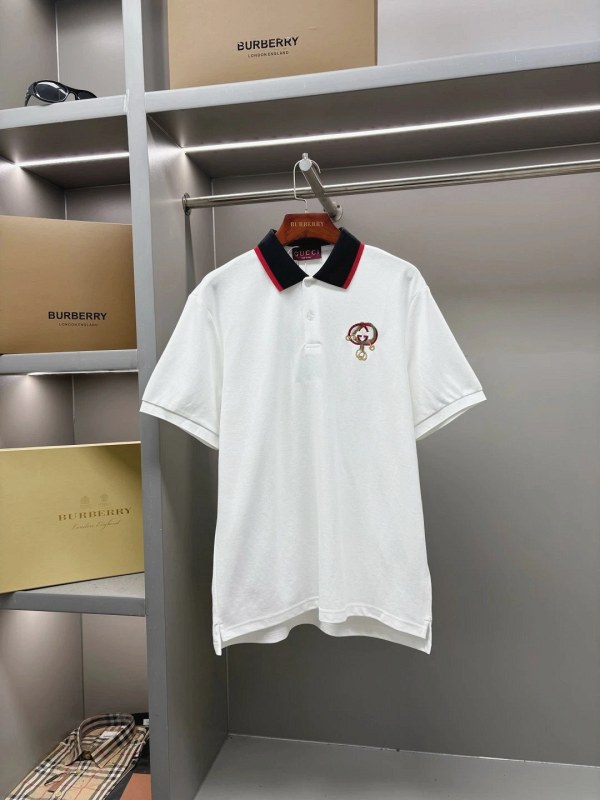
The stand collar carries a striped ribbed trim and measured about 3.5 cm deep on our sample, above a short button placket of roughly 12 cm. Ribbing is the part of a shirt like this that fails first, so we washed it cold and dried it flat. The collar band and cuffs came back to shape and the placket lay flat rather than curling. That is one wash, not a season.
Fit, measured flat
The listing offers unisex S to XXL in black, white and royal blue, with no chart to convert those letters into centimetres. Here is what we recorded for size M:
| Measurement | Our sample, size M |
|---|---|
| Chest, flat pit to pit | 52 cm |
| Body length, back collar to hem | 70 cm |
| Shoulder, seam to seam | 44 cm |
| Collar band depth | 3.5 cm |
| Placket length | 12 cm |
| Garment weight | 196 g |
After one cold wash and flat drying, body length came in about 1 cm shorter; chest width was unchanged within our margin of error. Compare the flat chest figure with a polo you already own before ordering, and size up if you intend to wear it over anything heavier than a vest. The shirt is listed in stock at $36.04, reduced from $38.00.
Two details that do not line up
The copy attached to this listing described a white polo with a black collar and red trim, captioned as a contrast-collar review. The catalogue description for the same item describes a white body with striped ribbed trim in black, white and royal blue — no red anywhere. Separately, the neck label and the older page name are reported to differ. Neither point settles anything about origin on its own, but together they mean you should match the option you select against its own photographs rather than against the prose.
Why $36.04 is not a Burberry price
The gap is roughly an order of magnitude. First-party Burberry polos are documented with 96 to 98 percent cotton bodies, elastane in the trims and mother-of-pearl buttons; this listing documents none of that, and its seller copy leans on factory and machine claims instead. None of this proves the shirt is bad. It does mean the brand name belongs in the same category as the 210 gsm line: a claim on a page, awaiting your own inspection.
Treat the brand name as a listing attribution until something in the parcel corroborates it.
Ordering, QC and the second payment
Agent mechanics matter more than usual on a low-value item. Free storage is commonly offered for up to about 100 days, which lets you combine this shirt with other orders before dispatch, and the international shipping leg is paid separately after the domestic delivery reaches the warehouse. Photo counts, storage limits and fee tables are agent-published and change, so confirm them at the time you order. Depending on destination and parcel value, import VAT and handling charges may also apply on arrival; the EU rules in this area have shifted recently, so check an official source rather than a community guide.
What we would do next
Request the ruler shot, confirm the colour against the photograph of the actual option, and decide before the free storage window closes. The shirt we handled is a competent mid-weight piqué with ribbing that survived its first wash. The branding is the part nobody at this desk can verify from a parcel.
Does the listing include a size chart?
No. The catalogue data has no specification table, no composition list and no garment weight. Our size M measured 52 cm across the chest and 70 cm in body length, so ask the agent for a ruler shot before approving the parcel.
Is the shirt a genuine Burberry product?
We cannot verify that. The brand appears only in the listing, the neck label and the page name are reported to differ, and $36.04 sits roughly a tenth of first-party Burberry polo pricing. Treat it as an attribution, not a confirmed fact.
Which QC photos should I request before consolidation?
Ask for front, back and three-quarter views, a ruler shot across the chest and body length, close-ups of the collar band, placket and chest embroidery, and a clear neck-label photo. The free agent set may cover only part of that.