Bape Classic Monkey Print T-Shirt Collection Review: Picking One of 80 Colourways Without Seeing the One You Get
We ordered two colourways of this $7.31 Bape cotton crew-neck and measured them: midweight 250–300 gsm body, relaxed cut, print holding after cold washes. The real risk is the 80-option dropdown, where the code you pick is the only thing your agent can check.
Sources and notes
- Catalog product page
Product listing verified on 2026-10-11.
Reading contents
The Bape Classic Monkey Print T-Shirt Collection is a single listing that behaves like a small catalogue: one SKU (7715767163), one $7.31 price, and a dropdown that enumerates roughly 80 colour options across nine code groups (D167, D168, D115, D169, D170, D081, D097, D109), plus black1, black2, black3 and white1. The garment itself is modest on paper — 100% cotton, 250–300 gsm, relaxed crew neck, short sleeve, straight hem, S–XXL, no hood. The complication is everything around the choice.
How we tested it
We ordered two size L tees through an agent, one on a white base and one on a black base, and asked for QC photographs from three angles plus a ruler shot laid flat across the chest before the parcel left the warehouse. Both shipped to Rotterdam, were photographed and weighed on the desk's 0.1 kg bench scale before opening, then worn for two full working days on city pavement. Each was washed cold three times and hung to dry rather than tumble dried.
The listing page is thin on the details that matter to a forwarded parcel. The stored product data carries a weight field of 0.00, so there is nothing to build a shipping estimate on, and the only garment measurements you get are the ones you extract from your agent's QC photos.
Fabric and weight, measured
Our two size L samples weighed 268 g and 274 g on the bench scale. The listing quotes a 250 g to 300 g fabric weight, which lines up with that once you account for a loose body and a short sleeve: this is a solidly midweight cotton tee, not a thin summer throwaway, and not heavyweight either. Both came out of the bag flat and slightly stiff, with a plain-weave surface that softened noticeably after the first cold wash.
Our measurements against the stated tolerance
| Measurement (size L, laid flat) | Our sample | Listing tolerance |
|---|---|---|
| Chest, pit to pit | 55 cm | ±2–3 cm |
| Body length, front | 70 cm | ±2–3 cm |
| Shoulder, seam to seam | 48 cm | ±2–3 cm |
| Sleeve from shoulder | 21 cm | ±2–3 cm |
Read the tolerance column as a warning rather than a footnote. A 2–3 cm swing on the chest is the difference between a relaxed tee and a snug one, and it is the reason two buyers can honestly describe the same size differently.
The colourway problem
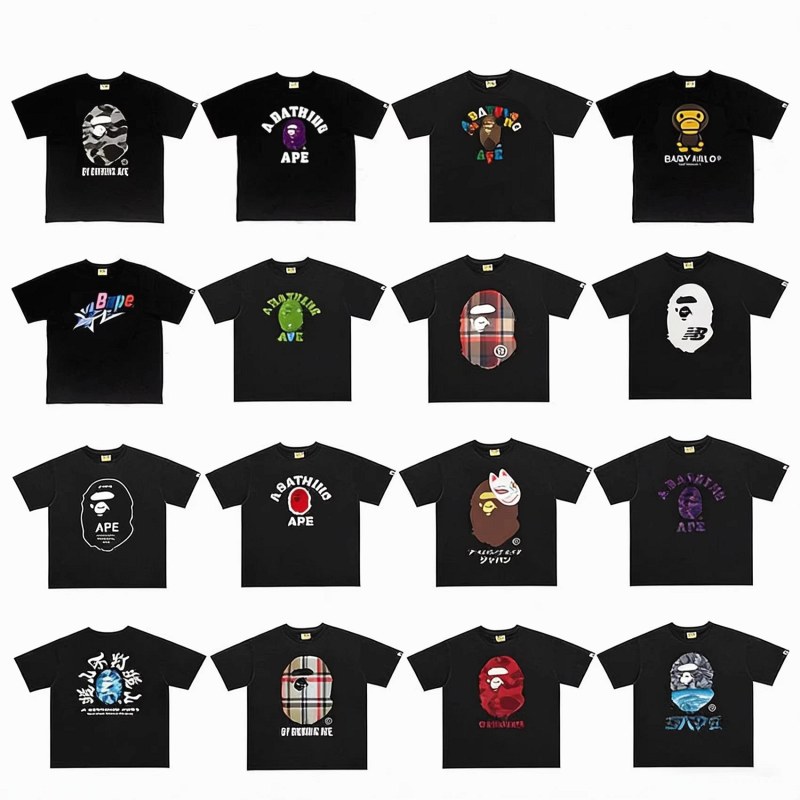
The specification list enumerates the options one by one, and it is worth understanding how they are built. The D-prefixed groups take a white or black body and pair it with one accent colour — red, yellow, grey, blue, green, brown, purple, cyan or pink — while the four numbered codes (black1, black2, black3, white1) appear to be plain solid bodies. Both of our samples matched their codes: white base with a red-accent motif, black base with a blue-accent motif, with the ape head and lettering printed as one combined front graphic.
What the listing does not do is give you a photograph of every option. The image set shows a spread of colourways, not a one-to-one picture for each code. In practice that means your agent's QC photo is the only record of what you actually bought, and if the code you entered was wrong, a QC shot of a plausible-looking Bape tee will not flag it for you. Confirm the colour on the photo before you approve international shipping.
Fit: our sample against the reports
Our size L measured roomy on a 178 cm tester, with a boxy shoulder line and a straight hem that sits at the hip. That reads as a comfortable, deliberately relaxed cut — a normal Western L, not a compression fitting. But that is one sample, and buyer accounts disagree in both directions. One regular Bape buyer on r/bapeheads describes the brand as Asian sizing, saying a Gap or 5.11 XL wearer often needs XXL here, and a separate reviewer around 180 cm and 88 kg found his XL too snug. Other owners say the tees run true to size and that you should only size up when you sit between sizes. External sizing guides for the brand broadly support the smaller-cut argument.
Our position: if you are near the top of a size band or you want a genuinely loose streetwear drape, take the size up. Do not spend the savings on a wrong-size tee you then have to re-forward.
Print, wash and what we would watch
The front print is the whole point of the design, so we treated it as the wear item most likely to fail. After three cold washes and air drying, the graphic on both samples showed no lifting or flaking at the edges. That matches the long-running view among Bape owners that the prints last years on cold wash and air dry, and that heat is what cracks them. Machine drying is the one thing we would not do with this tee.
Two cautions we could not fully resolve. One buyer reported a faint formaldehyde-like chemical smell on a new Bape tee straight out of the bag; neither of our samples carried an obvious odour beyond new-garment bag smell, but it is worth airing the parcel out before wearing. Separately, a retail buyer said current Bape tee cotton feels smoother and cooler than the coarser fabric of older runs — a change noticeable enough that it may read as a downgrade if you are comparing against a favourite from five years ago. Our samples were smoother than expected too, though whether that is a fabric swap or just a fresh finish we cannot confirm from two garments.
Buying it through an agent
This is where a $7.31 tee stops being a $7.31 decision. Because the listing carries no usable packed weight, you should ask your agent to weigh the item after inspection and give you that number before you commit to a shipping line. Two size L tees plus poly mailer landed comfortably under half a kilogram, so a bundle of these consolidates well; five tees will still price out as a light parcel on most lines, which is the main reason to buy the collection in multiples rather than one at a time.
Our checklist for this listing:
- Request QC photos from three angles plus a ruler shot on the chest, and confirm the exact colour code against the photo.
- Compare flat measurements with the size chart rather than the letter on the label, remembering the stated 2–3 cm tolerance.
- Ask the agent for the packed weight before booking the line, since the listing provides none.
Verdict
As a garment, this is a competent midweight 100% cotton crew-neck at a very low unit price, with a print that survives sensible care. As a purchase, it is a sizing and colour-matching exercise: the 2–3 cm tolerance and the conflicting fit reports mean you should measure rather than trust the label, and the 80-option dropdown means the QC photo is your only proof of what you bought.
What do the colourway codes like D167 and D081 mean?
Each D-prefixed group pairs a white or black body with one accent colour — red, yellow, grey, blue, green, brown, purple, cyan or pink. The four numbered codes (black1, black2, black3, white1) appear to be solid bodies. The listing shows no individual photo per code, so confirm the colour on your agent's QC shot.
How much does one tee add to my parcel weight?
The listing itself states no usable packed weight, so treat any estimate as provisional. Our two size L samples weighed 268 g and 274 g each before packing, which puts a single tee comfortably under 0.3 kg. Ask your agent to weigh the item after inspection, before you book a shipping line.
Will the monkey print survive regular wear and washing?
In our testing, three cold washes followed by air drying produced no lifting or flaking at the print edges, which matches what long-time Bape owners report. Heat is the enemy: owners say machine drying is what cracks these screen prints, so skip the dryer.