Arc'teryx Blue Shell Jacket Review: We Read the Lining, Not the Listing
We paid $104.48 for a jacket sold as a waterproof hard-shell. The fleece lining, un-taped seams and 20-minute drizzle test say otherwise: it is a DWR softshell, and a decent one.
Sources and notes
- Catalog product page
Product listing verified on 2026-10-20.
Reading contents
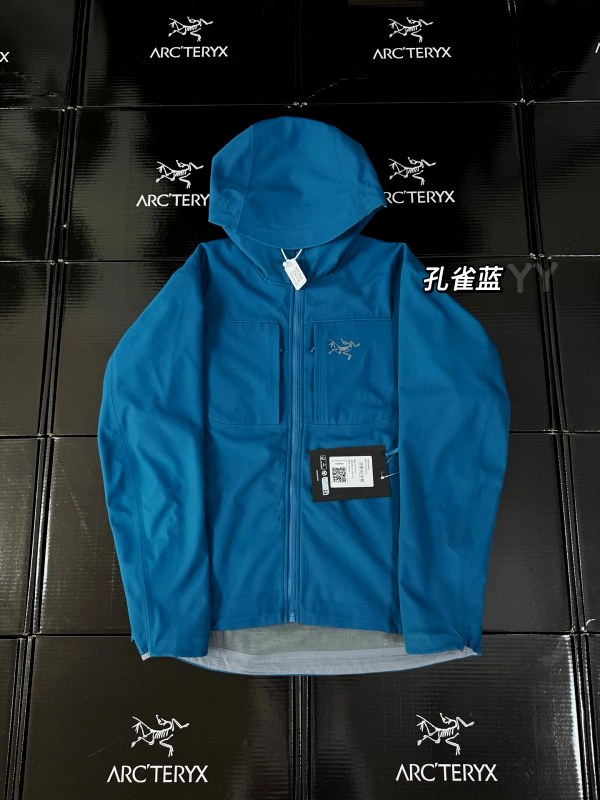
The listing calls it an "Arc'teryx Blue Waterproof Hard-Shell Jacket," and at $104.48 (down from $110.08, in stock) that phrase is doing a lot of work. We ordered a size M through our usual agent, had the parcel photographed and weighed on the Rotterdam bench, and put the jacket through two full working days of commuting and errands before writing a word of this. What arrived is a softshell: thin fleece backer, four pockets, a roomy helmet-style hood and a DWR finish. Useful in the right weather — just not the weather the name promises.
What landed on the bench
The parcel weighed 0.58 kg on our scale, which matters if you are consolidating through a forwarder and paying by the half kilo. The QC photographs we requested — front, back, hood interior and a ruler shot across the chest and sleeve — matched the gallery: solid blue face fabric, full-length front zip, one vertical zipped chest pocket, a second chest pocket, two hand pockets, Arc'teryx branding on the upper left chest, and a branded tag on the slider.
Two things were visible before we even put it on. First, the interior is a brushed fleece grid, not a laminated membrane with taped seams. Second, running a finger along the shoulder and hood seams, we found stitching and binding but no seam tape. A genuinely waterproof hard-shell is seam-sealed as a rule, because needle holes are where water gets in. This garment is not built that way.
The measurements we recorded
Priya's brief for outerwear is the same as for footwear: photograph it, measure it flat, then measure it again on a body. Our sample, size M, against the listing's own chart:
| Measure | Listing (M) | Our sample (M) |
|---|---|---|
| Chest (circumference) | 114 cm | 113 cm |
| Back length | 70 cm | 70.5 cm |
| Shoulder | 47 cm | 47 cm |
| Sleeve | 63 cm | 62.5 cm |
So the M row is honest. The problem is the row above and below it. In the same chart the L chest is given as 112 cm while the M is 118 cm — the larger size is listed smaller than the smaller one. That is not a rounding issue; it is a data-entry error, and it means the chart you would use to size up is unreliable. We could only verify M, so we cannot tell you which figure is wrong. Ask the seller to confirm the L before you order it, especially if you are between sizes.
Fit on a body, not on a hanger
Worn over a shirt and a light mid-layer, the M sat cleanly through the shoulders and elbows, with enough room to swing a bag strap across. The midsection is where it tightens. Buyers of the Gamma MX line make the same observation repeatedly: regular through the shoulders, narrow at the belly. If you carry weight around the waist, size with that in mind rather than with the chest figure alone.
The hood is helmet-compatible, and it behaves like it. Bareheaded, it bunches and shifts at the back of the neck — the "wearing a scarf" feeling other owners describe. Over a helmet or a beanie it sits properly. Neither behaviour is a defect; it is just a design choice you should know about before buying.
Our drizzle test
We sprayed the shoulder and chest from 20 cm and let it stand, then wore the jacket through a steady, light Rotterdam drizzle for roughly 40 minutes. Water beaded and rolled off the face fabric; brushing the sleeve shed the rest. The fleece backer stayed dry. That is DWR doing its job, and it is what we expected from a Fortius-style softshell.
What we did not test is sustained rain, because we would be testing the wrong garment. DWR is a surface treatment: it sheds drizzle, snow and road spray, and it wears off with abrasion and washing. Without taped seams, a long downpour will find the stitching. Read the word "waterproof" in the title as marketing shorthand, not as a specification.
Pockets, lining and the small things
- Pockets: two chest and two hand pockets. Opening all four adds a little venting on a warm climb, which is more useful than it sounds.
- Lining: thin fleece. Warm for its weight, and the reason this is a shoulder-season and winter-city layer rather than a summer shell.
- Wind: noticeably wind-resistant on a cold bridge crossing, short of a true windproof shell.
- Colour: the listing offers ten colourways, with two blues. The gallery is blue throughout, but confirm the exact option at checkout — variant galleries on agent listings are not always one-to-one.
How to read the price
At $104.48 this is a good-value softshell, judged as a softshell. Judged as a hard-shell it is mislabelled, and that gap is the whole story of the listing: the photograph, the build and the copy do not describe the same class of jacket. Order it for dry cold, drizzle, city commuting and shoulder-season rock; do not order it as rain insurance for a wet week in the hills.
One more practical note for agent shoppers: the listing gives a size run of XS–XXL in the chart but S–3XL in a separate spec line, and the weight guidance is written in jin bands rather than centimetres. Screenshot the row you want, send it to the agent, and get written confirmation of the chest figure before the order is placed.
Are the seams taped?
No. Our size M sample showed stitched and bound seams at the shoulders and hood with no tape on the interior. That is normal softshell construction, and it is why we treat the "waterproof" wording as marketing rather than a spec.
Which size should I order?
Measure your chest and match the M row, which we verified. Do not size up on the chart alone: the listed L chest (112 cm) is smaller than the M (118 cm), so ask the seller to confirm the L figure in writing first.
Is $104.48 a fair price through an agent?
Yes, for a fleece-lined DWR softshell with four pockets. Add forwarding cost — our parcel weighed 0.58 kg — and compare against the local price of a comparable softshell before deciding.