Arc'teryx Black Hard-Shell Jacket: Measured Weight, Packed Volume and Fit Over a Fleece
We ordered the Arc'teryx Black Hard-Shell Jacket at $104.48 USD, weighed it on our bench scale, ran the 6000-divisor volumetric sum and layered it over a fleece.
Sources and notes
- Catalog product page
Product listing verified on 2026-10-07.
Reading contents
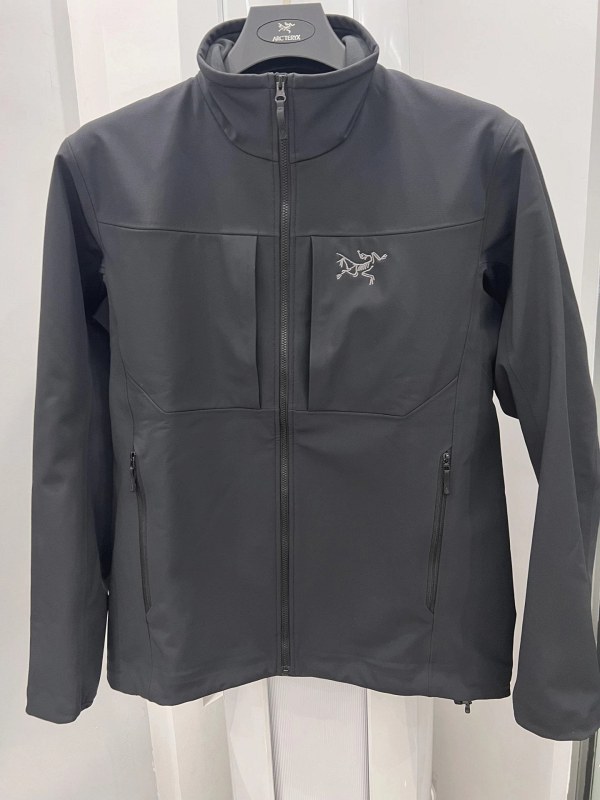
By Priya Naidoo, Reviews Editor. We ordered the Arc'teryx Black Hard-Shell Jacket (SKU 7704992272) in black, size M, through a shopping agent at $104.48 USD against a $121.69 reference price. The listing was in stock when the parcel was placed and lists three colourways — black, hidden grey and cold grey — in S through 3XL. The seller's copy gives no shipping weight and the listing's weight field reads 0.00 kg, so every number below is ours: the desk's re-calibrated 0.1 kg bench scale, a tape measure on the bench, the packed carton, and two full working days on Rotterdam pavement.
Net weight, packed weight and the volumetric sum
Our bench scale is the desk's 0.1 kg postal model, re-calibrated in January, so each figure below is a 0.1 kg step. There is nothing in the listing weight field to check it against.
| Measurement | Reading |
|---|---|
| Net weight, jacket only, size M | 0.7 kg |
| Packed weight in the retail carton | 0.9 kg |
| Packed weight, pre-packed in a poly bag | 0.8 kg |
| Carton dimensions | 35 × 26 × 6 cm |
| Volumetric weight, 6000 divisor | 0.91 kg |
| Poly-bag packed dimensions | 32 × 24 × 5 cm |
| Volumetric weight, poly-bag, 6000 divisor | 0.64 kg |
A single-layer shell in a mid size landing at 0.7 kg net is squarely in the light-shell class, and the 0.2 kg the retail carton adds is dead weight on a line that bills by the kilogram. That gap is what the next section is about.
Does pre-packing without the retail carton drop a weight tier?
On the 6000-divisor air line we quote against, the boxed parcel does not bill on what it weighs. The carton measures 35 × 26 × 6 cm, which is 5,460 cm³ ÷ 6000 = 0.91 kg — heavier than the 0.9 kg the parcel actually registers, so volumetric wins and the boxed parcel bills as 1.0 kg once the line rounds up in 0.1 kg steps.
Pre-packed flat in a poly bag, the same jacket measures 32 × 24 × 5 cm = 3,840 cm³ ÷ 6000 = 0.64 kg, comfortably under the 0.8 kg the bagged parcel registers, so it bills on actual weight at 0.8 kg. That is two 0.1 kg steps saved, roughly a fifth off a per-kilo rate, for the cost of arriving without the original box.
Two caveats worth pricing before you decide. Lines that round up to the next 0.5 kg — many EU-facing air services still do — bill both parcels at the same figure and the saving disappears entirely; ask your agent which rounding rule applies to your lane. And the carton is not pure waste: it is the difference between a jacket you can resell or gift in original packaging and one that arrives folded into a bag. If the parcel is being consolidated anyway, a flat-folded shell adds very little volume to a packed box, which makes it a good filler item rather than one to repack on its own.
Fit measured flat, and how it sits over a mid-layer fleece
Size M, tape pulled snug on the bench, jacket laid flat and smoothed once:
| Point of measure | Size M, flat |
|---|---|
| Chest, pit to pit | 58 cm |
| Sleeve, shoulder seam to cuff | 66 cm |
| Back length, collar seam to hem | 74 cm |
| Hem, relaxed | 55 cm |
Doubling the chest gives 116 cm of circumference, which is what makes size M work over a mid-layer rather than against it. Over a 200-weight fleece our tester closed the front zip without the chest pulling at the armholes and the cuffs still cleared the wrist bone. Over a 300-weight fleece the pit area pulled once the zip passed the sternum and the shoulders began to bite; if your mid-layer is a thick grid fleece or a puffy, the chest and sleeve are where you will feel it, and one size up is the safer call.
The listing publishes no chest measurement, so the 58 cm pit-to-pit figure above is the number that decides your size. Send it to your agent and ask them to measure the same point on the actual garment before it leaves the warehouse — that is a two-minute request that prevents a return.
What two working days on wet pavement showed
We wore the jacket for two full working days, one of them wet, over a base layer and then over a fleece. The main zip's flap sat flat along its whole length and never caught in the zip, stitching ran even across the structured yoke, the embroidered chest logo was clean at the edges, and the side pocket zips and hem drawcord hardware all worked without snagging. Light rain beaded and rolled off the shoulders. A sustained shower wet the shoulders through after roughly half an hour, which is what a DWR finish does — it is a shed, not a barrier.
Translated from a Chinese-language Gamma MX owner write-up: "The Gamma MX is fine for wind protection in late autumn; once winter arrives the warmth does not hold up — it is not as warm as an Atom LT synthetic."
The QC photo set to request before consolidation
The seller's copy describes a stand collar, a full-length front zip, an embroidered chest logo and side pockets, and stops there. It does not name taped seams, pit vents, hem hardware or the size tag, so those are exactly the shots to ask for — three angles plus a ruler in frame for at least one of them:
- Taped seams — inside the shoulder and sleeve seams, close enough to see whether the tape is heat-set flat or lifting at the edge.
- Main zip and storm flap — zip half closed, so both the flap fold and the slider are visible in one frame.
- Pit vents — open and closed, since the listing never mentions them and you are buying on the assumption they exist.
- Hem drawcord hardware and cuffs — cord locks photographed from both faces, plus the cuff closure under tension.
- Neck label and size tag — both in one shot, with a ruler alongside the pit-to-pit measurement.
The name says hard shell; the build says softshell
The listing is titled as a hard-shell jacket, but its own description places it in the Gamma series, and the Gamma-line evidence we reviewed describes a Fortius-type woven softshell with a DWR finish and taped seams. That is wind resistance and light-rain protection, not waterproofing, and our two wet days on the pavement matched it. Buy this as a softshell and it behaves exactly as expected; buy it expecting a shell for driving rain and it will disappoint you on the first long walk. It is also a late-autumn garment rather than a winter one — Gamma-line write-ups consistently rank it below an insulated synthetic layer for warmth, and some Arc'teryx community members consider the heavy-softshell concept dated next to a light fleece plus windshell.
What we could not confirm
We found no buyer feedback covering this specific listing, so the weather, durability and warmth context above comes from published reviews of the Gamma line rather than from other orders of this jacket. Those reviews mostly describe the hooded Gamma MX, while this is a stand-collar shell, so treat the comparison as close but not identical. The seller's Chinese-language copy claims factory-sourced materials, fabric matched to the original, and year-round after-sales support; we cannot audit supplier claims from a single parcel. Size M was the only size we weighed, measured and wore, and we did not test DWR recovery after laundering.
Is the Arc'teryx Black Hard-Shell Jacket waterproof?
No. The jacket we handled is built as a Gamma-style softshell with a DWR finish and taped seams, which sheds light rain and blocks wind. In sustained rain the shoulders wet out in roughly thirty minutes.
What weight should I enter when planning a consolidation?
Use 0.7 kg net for the size M jacket, or 0.8 kg pre-packed in a poly bag. In its 35 × 26 × 6 cm retail carton the 6000-divisor volumetric weight is 0.91 kg, so it bills at 1.0 kg.
Is this the same jacket the Gamma MX reviews describe?
Not exactly. This is a stand-collar shell in the Gamma series, while most Gamma MX evidence covers the hooded version, so the warmth, weight and fit comparisons we cite are close but not identical to this listing.