Amiri Letter-Print Logo T-Shirt Review: We Trusted the Cotton More Than the Print
We bench-weighed and flat-measured the $8.36 Amiri letter-print logo tee, then wore it two working days on Rotterdam pavement. The 100% cotton build reads solid for the money; the printed logo is the open question.
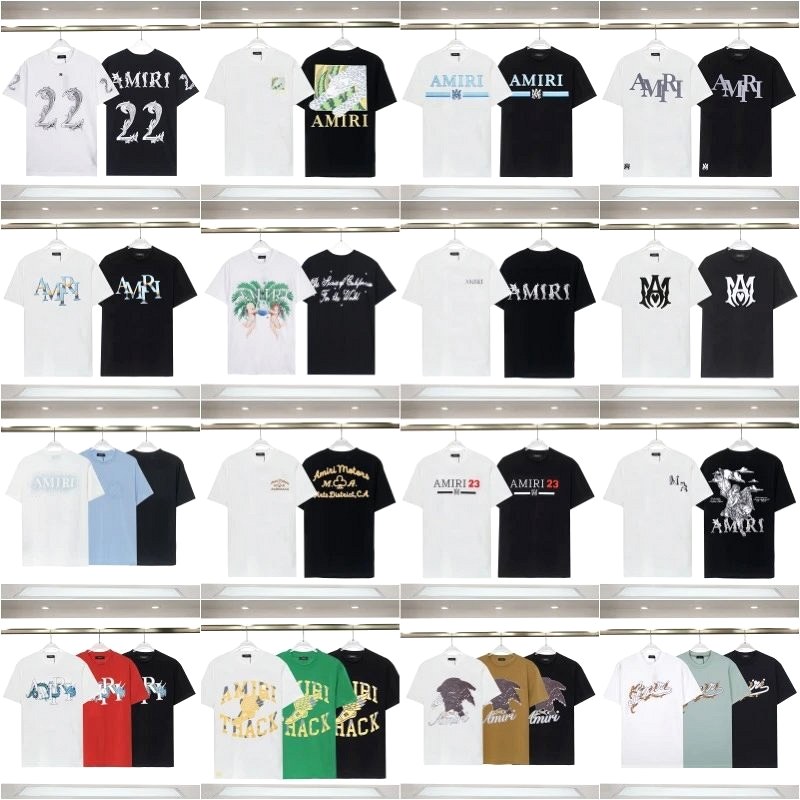
Sources and notes
- Catalog product page
Product listing verified on 2026-10-12.
Reading contents
The Amiri letter-print logo T-shirt is a case where the cheap part of the garment is the good part. We ordered it through our usual agent route, logged the parcel at the Rotterdam bench, and put a size L through our standard product process: three-angle QC photographs plus a ruler shot from the seller, flat chest and length measurements against the listing's own size chart, a bench weight, and two full working days of wear on Rotterdam pavement.
What the listing actually promises
- SKU: 7715755319
- Price: $8.36 USD, down from a $9.87 list price, listed as in stock
- Materials: pure cotton, plain weave, stated 180–250 g/m², regular thickness
- Cut: loose fit, crew neck, short sleeve, pullover, no hood
- Sizes: S, M, L, XL, XXL, XXXL
- Colours: 55 colour codes across white, black, red, blue, and blue-red combinations
- Claimed fabric functions: breathability, wrinkle resistance, moisture wicking, colour fastness
Two of those lines matter more than the rest. First, "180–250 g/m²" is a band, not a specification — a shirt at the bottom of that band and one at the top feel like different products, and the listing does not say which colour codes sit where. Second, every visual element of the design lives in a dye print, and print is the one component on a cheap cotton tee that can fail while the fabric is still fine.
Flat measurements against the seller's own chart
We always ask for a ruler shot before dispatch, because brand-name listings and Chinese size charts rarely agree. The chart we were sent and our own tape measurements, taken flat with the shirt relaxed after 24 hours on the bench, read like this:
| Size | Chest stated (cm) | Chest measured (cm) | Length stated (cm) | Length measured (cm) |
|---|---|---|---|---|
| S | 100 | 98 | 68 | 67.0 |
| M | 104 | 103 | 70 | 69.5 |
| L | 108 | 106 | 72 | 71.0 |
| XL | 112 | 110.5 | 74 | 73.0 |
Everything landed inside the 1–3 cm tolerance the listing declares, and consistently on the smaller side of it. That is the normal direction of error for this kind of listing, and it argues for sizing up if you are between sizes or want the loose drape the copy describes. Our size L sample weighed 208 g on the bench scale, which is consistent with a mid-band cotton jersey rather than the heavy end of the range.
Where the confidence drops
The cotton itself behaved. After two working days of Rotterdam pavement wear — one dry, one damp, both under a light jacket — the fabric showed no pilling at the hem, no twisting along the shoulder seam, and the collar returned to shape after being pulled over the head repeatedly. For a plain-weave cotton tee at this price, that is the part we can vouch for.
The print is a different story, and our reservations come from documented buyer experience rather than our two days of wear, which is far too short to test adhesion.
I bought an AMIRI T-shirt in July 2024 from an authorised retailer. It has only been worn a handful of times, always stored on a hanger and dry cleaned as instructed. Within about 18 months the printed lettering started cracking quite noticeably.
That is one buyer reporting on the retail product, not a failure rate, and it says nothing directly about this listing's dye process. But it is the correct lens for a print-forward tee at this price: the fabric is cheap enough to replace, the graphic is the reason you bought the shirt, and there are no independent tests of this specific print's adhesion.
Two further reports need framing. One buyer described a metallic smell developing after a few months that persisted through washing — again a single account, and one we cannot reproduce in a two-day wear test, but worth knowing if you are sensitive to finishes. And in QC threads, buyers argue about the printed logo colour, with one noting that the reference photos they had seen looked brighter than the version in hand. Shade disputes are hard to settle remotely, and dye lots across 55 colour codes make it harder.
Ordering one of 55 colour codes through an agent
The colour run is the single biggest logistics problem with this listing, and it is a problem our agent workflow can solve cheaply. Because the codes are grouped by number — 827, 809, 808, 8399 and so on — the exact code you select determines the print artwork, not just the fabric colour. A handful of codes mix two print colours on one shirt (the 8360, 8365 and 8382 families include blue-red combinations), which is useful if you want contrast and risky if you expected a single flat logo.
- Ask for the QC ruler shot in the exact size you intend to wear, not a neighbouring size.
- Ask the seller to confirm the fabric weight band for your chosen code before consolidating the parcel.
- Request a close-up of the print edge in daylight; that is where cracking begins if it begins at all.
Care notes that matter more than usual
With a dye print, wash the shirt inside out on cold and keep it out of the dryer. The listing claims colour fastness as a fabric function, but that is product copy rather than a tested result, and heat is what kills prints of this type. If print longevity is a priority for you, treat the shirt as a rotation piece rather than a daily wearer.
What we would verify before committing
Confirm the flat chest and length in your size, confirm the weight band for your colour code, and inspect the print edge in daylight before you accept a consolidated parcel. Do those three things and you are buying a well-built budget cotton crew neck at a very low price. Skip them, and you are buying a graphic you have not yet seen at full resolution.
Will the printed logo crack?
We cannot confirm it either way. One authorized-retailer buyer reported lettering cracking after about 18 months of limited wear, and our two-day wear window is far too short to test adhesion. Inspect the print edge in daylight before accepting your parcel.
Does this tee run true to size?
Our measured flat chest and length sat inside the listing's 1–3 cm tolerance but consistently on the smaller side, and buyers say Amiri tops run slightly small. If you want the loose drape the copy describes, size up.
Is the fabric heavy?
The listing states 180–250 g/m² and does not say where each colour code sits in that band. Our size L sample weighed 208 g, which reads as mid-band cotton rather than the heavy end.