Stussy Letter-Print Black Tee Review: 250–300 gsm Cotton at $8.06
We measured and wore this $8.06 Stussy letter-print tee. The listed 250–300 gsm long-staple cotton reads genuinely midweight and the cut is relaxed, but the chest print's method is still unconfirmed for this listing.
Quellen und Hinweise
- Catalog product page
Product listing verified on 2026-10-10.
Inhalt
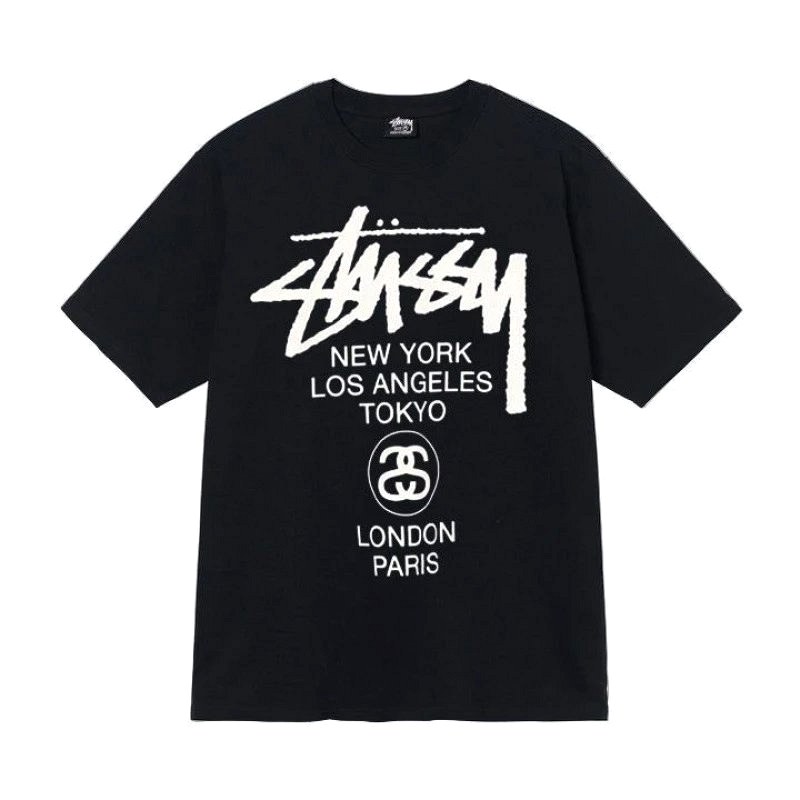
This Stussy tee arrived at our Rotterdam bench inside a small agent parcel, weighed and photographed before anyone cut the tape. It sells for $8.06 against a $9.46 original, is listed as in stock, and ships from a Weidian store under SKU 7718808120. The catalog describes a black cotton body, short sleeves, a crew neck and a large white chest graphic combining the brand name with city names and a circular emblem.
Here is what we could confirm from the garment in hand, and the parts of this listing that no photo settles.
What we ordered, and how we checked it
We requested QC photographs from three angles plus a ruler shot before the parcel left China, then repeated the key measurements ourselves on the flat tee: chest width pit to pit, body length from the shoulder seam to the hem, and sleeve length from the shoulder point. Those numbers were checked against both the listing and the desk's own chart rather than against each other. Once the tee was here, we wore it for two full working days on Rotterdam pavement — under a jacket in the morning, over a T-shirt in the afternoons — and looked at the chest graphic under raking light and magnification.
That last check matters more than it sounds. On a printed cotton tee you can usually tell which process produced the graphic: screen-printed ink soaks into the fibre and shows a slightly irregular, grainy edge under a loupe, while a heat-transfer film sits on top of the weave as a smoother, glossier layer that feels faintly plastic to the fingertip. Retailer listings for Stussy's own sport tees describe screen-printed graphics and note that appearance may vary and can crack around the seams, so a certain amount of surface wear is normal even on legitimate stock.
Fabric and weight: what 250–300 gsm long-staple cotton feels like
The catalog lists pure long-staple cotton at 250 gsm to 300 gsm, with a non-iron treatment and breathable, wrinkle-resistant and moisture-wicking functions. In hand, the blank behaves like a midweight cotton jersey: it hangs off the shoulder instead of clinging, holds its shape through a working day, and comes out of a bag with few creases. It is not a heavyweight loopback feel, and it is not the thin, semi-transparent cotton you sometimes get at this price point.
One caveat worth holding on to: 250–300 gsm is a range, not a fixed weight. That width is why buyers of cheap Stussy tees sometimes describe the blanks as soft and pretty thick while others find them ordinary. If weight matters to you, ask which end of the range your colour sits at.
Fit, sizing and the 1–2 cm tolerance
The listing calls this a loose fit in the catalog's basic style bracket, sized S through XXL. Our sample matched that description: relaxed through the body, not oversized-sloppy, with the crew neckline sitting where you would expect. Category guidance on Stussy tees generally runs the same direction — buyers report that going true to size already gives a relaxed look, and that sizing up is for people who want something baggier than intended.
The listing also states a 1–2 cm measurement tolerance, which is normal for this kind of production and still the single most common reason a tee feels wrong on arrival. Two centimetres across the chest is the difference between close and roomy. Treat the ruler shot from your warehouse as the measurement you are actually buying, not the size label.
The chest print is the real open question
Public reporting on Stussy tees is mixed. Buyers of cotton reps describe the blanks as soft, fairly thick and accurate to the original, but the same discussions flag a shortage of genuinely high-quality Stussy tees and raise concerns about chest prints wearing over time. None of that describes this specific listing, and our hands-on time cannot answer it either — a print's durability shows up after repeated washing, not after two working days.
What we can say is that print method is checkable before you pay; print longevity is not.
So the useful move is to ask your agent to photograph the graphic up close at the warehouse and tell you which process was used. A screen print with a soft edge and ink that reads as part of the cloth is the better sign. A thick, uniform, slightly shiny layer that you could pick at with a fingernail is the weaker one.
Colour run and reordering
This is one of the wider colour runs we have logged on a single tee listing, spanning the 848–918 series in black, white, blue, red, green, beige, grey and brown shades. The practical benefit is reordering: if a shade suits you, the same link should carry it again. The practical risk is dye lots. Blacks and deep blues are the shades most likely to differ subtly between batches, and a second order placed months later is not guaranteed to match the first one exactly.
Care, shrinking and cotton honesty
It is listed as pure cotton, and 100% cotton Stussy tees are widely reported to shrink when washed. Warm water plus a tumble dryer is the combination to avoid; hand wash or a cool machine cycle and hang drying keeps the listed measurements closer to the ruler shot you approved. If you are between sizes and want to keep the relaxed drape, hang drying is the cheaper insurance.
What the $8.06 does not include
The Weidian price is the item only. Because most Weidian sellers ship within mainland China, an overseas order usually runs through a shopping agent or parcel forwarder, and that second leg is where a cheap tee stops being cheap.
| Cost line | When it applies | What to watch |
|---|---|---|
| Product price | At order | $8.06 listed; variant pricing can differ by colour |
| China domestic delivery | Seller to warehouse | Often a few yuan, sometimes free |
| Agent service fee | At purchase | Ranges from zero to roughly 10% depending on agent |
| International shipping | When you submit the parcel | Chargeable weight is the greater of actual and volumetric weight, and the first 500 g costs the most |
| Import VAT or duty | On arrival | Destination rules apply; Netherlands thresholds are low |
A midweight cotton tee is dense for its size, so it is one of the better items to ship — no bulky box, no volumetric penalty from air. A single tee, though, still pays a whole first-500 g base fee, which is why one shirt shipped alone can cost more in postage than it cost to buy. Fold it into a consolidated parcel with a hoodie or a pair of trousers and the per-item shipping drops sharply. Repacking that removes the seller's poly bag and any filler helps the volume figure without exposing the garment.
What we would confirm before paying
- Print method: screen print or heat transfer, with a close-up warehouse photo of the chest graphic.
- Actual measurements: chest width, body length and sleeve length off the ruler shot, not the size label.
- Colour on arrival: confirm the exact shade name in the order notes, since the run is long and variants are easy to mix up.
Check those three things at the warehouse and this becomes a low-risk order: a midweight cotton graphic tee for eight dollars, in a cut that suits the way most people actually wear a Stussy shirt.
Den vollständigen Hinweis lesen →
Can I order this tee directly, or do I need an agent?
Weidian sellers generally ship within mainland China only, so most overseas buyers route the order through a shopping agent or parcel forwarder. Put the exact size, colour name and quantity in the order notes, since the colour run is long.
How much does shipping add to one tee?
International shipping uses the greater of actual and volumetric weight, and the first 500 g carries the highest rate. A single tee can therefore cost more to post than to buy. Consolidating it with other items spreads that base fee.
Can my agent check the print before the parcel ships?
Yes. Ask for a close-up QC photo of the chest graphic so you can judge whether the ink looks absorbed into the cotton or sits on top as a glossy film. Print method is visible that way; print durability is not.